
KLAK / Solare Zukunft e.V.
- Open manual source
Websitehttps://fahrradkino.org
KLAK (KlimaAktionsKino) was a publicly funded climate-education bicycle cinema run by Solare Zukunft e.V. from Freiburg, 2016–2019. Its technical manual of 20 December 2018 publishes the ten-trainer, LiFePO4-buffered system down to its shutdown logic — the most completely documented system in this corpus.
Key facts
“Trotz des großen Engagements reichte die selbst erzeugte Energie nicht vollständig aus. Rund 30 % des zusätzlichen Akkus wurden benötigt. Ursachen dafür waren vor allem, dass die Fahrräder gegen Ende nicht mehr dauerhaft besetzt waren.”
Translation: Despite the great commitment, the self-generated energy was not fully sufficient. Around 30% of the auxiliary battery was needed. The main cause was that the bikes were no longer continuously occupied toward the end.
KLAK was a project of Solare Zukunft e.V. in Freiburg and UfU e.V., funded under Germany's National Climate Initiative. Its system is battery-buffered: roller trainers with generators feed a central unit holding a LiFePO4 battery and an inverter, which supplies 230 V AC to a fixed set of consumers — projector, sound system and playback laptop. The centrepiece was a sixteen-city Fahrradkino tour in 2018, and complete systems were installed for six months in four youth hostels. Solare Zukunft continues to run school deployments; the Karlsruhe project day of 12 January 2026 is the basis of the active status.
Specifications
| Field | Value | Confidence | Sources |
|---|---|---|---|
| Pedalling stations | 10 roller trainers with generatorsTen people must pedal simultaneously; the manual asks for a group of at least thirty. | Documented | 1 |
| Generator rating per trainer | up to 250 WAverage 50–60 W per bike per the manual's information sheet. | Documented | 1 |
| Per-bike average output | 50–60 W | Documented | 1 |
| Generator type | not disclosedThe manual describes the friction roller and screw tensioning but not the generator's construction. | Not disclosed | 1 |
| Buffer chemistry | LiFePO4 (lithium iron phosphate) | Documented | 1 |
| Buffer capacity | not disclosed | Not disclosed | 1 |
| Output | 230 V / 50 Hz, maximum 500 W | Documented | 1 |
| Projector draw | 340 WProjector model not disclosed. | Documented | 1 |
| Auto-shutdown | after 10 minutes without pedalling; also at 100% state of chargeWarning below 20% SOC; events should start at 60–70% SOC. | Documented | 1 |
| Field output, Ludwigsburg (November 2024) | about 400–500 W from 10 bikesDistrict press release; rotating schoolchildren. | Operator-stated | 4 |
| Battery draw, Karlsruhe (12 January 2026) | about 30 % of the auxiliary batterySchool report; bikes were not continuously occupied toward the end. | Operator-stated | 3 |
| Project grant | 634,468 € (funding code 03KF0034A/B, 1 May 2016 – 30 April 2019) | Documented | 2 |
History
The National Climate Initiative funded the project from 1 May 2016 to 30 April 2019 2,5. The technical manual is dated 20 December 2018 and remains the current published version 1. After the project closed, several Fahrradkinos covered regional demand across Germany 2 and Solare Zukunft kept the system in use for schools 6. The Zurich collective Vélorution's VéloKino credits "© fahrradkino.org" as its design source 7.


Technology
Each trainer's generator has a friction roller pressed against the rear tyre by an adjusting screw, and two cable harnesses of five Anderson Powerpole connectors each carry the ten outputs to the central unit 1. The manual fixes the consumers at projector, sound system and playback laptop and warns against adding anything else: the projector alone takes 340 W of the 500 W maximum, while ten riders at the 50–60 W average generate 500–600 W, a margin that keeps the battery roughly neutral as long as every station is occupied 1. Both lids of the control unit stay off during operation for cooling, and the projected image carries a colour-coded bar for each of the ten bikes with a battery indicator showing whether the pack is charging or discharging 1. At the Karlsruhe project day, students rotated every five to fifteen minutes under a live wattage display, and the auxiliary battery covered the shortfall once the bikes were no longer continuously occupied 3.


People and community
The manual lists Rolf Behringer of Freiburg as its contact, and Behringer explained the system to the students at the Karlsruhe event 1,3. It recommends participants from about age ten and excludes mountain-bike tyres for noise 1.
In their own words
"Um den Akku zu schonen, schaltet die Zentraleinheit automatisch ab, wenn länger als 10 Minuten keiner radelt. Zuvor erfolgen verschiedenen Warnungen, optisch und akustisch." — To protect the battery, the central unit switches off automatically if nobody pedals for more than 10 minutes. Various optical and acoustic warnings come beforehand. 1
"Alle zehn 'menschlichen Kleinkraftwerke' sollten im grünen Bereich fahren. … Der gelbe Bereich bedeutet: Teil dir deine Kräfte ein. Der rote Bereich bedeutet: Da geht noch mehr." — All ten 'human mini power plants' should ride in the green zone. … The yellow zone means: pace yourself. The red zone means: there is more in you. 1
Related
-
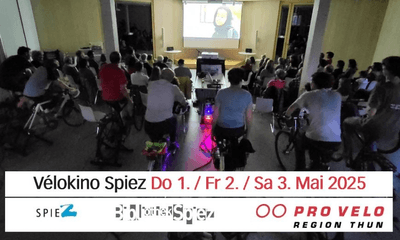
Vélorution Zürich VéloKino / velokino.ch / VCS / Pro Velo
Active last verified 2026-09Design descendant — the Swiss VéloKino credits © fahrradkino.org
-
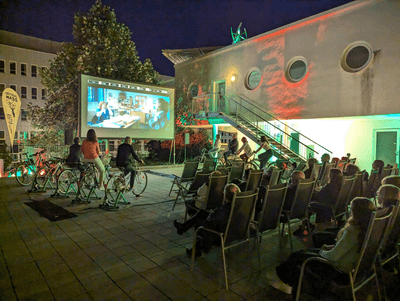
Oekotrainer.de
Active last verified 2026-09Same battery-buffered AC topology; the rental fleets behind many German events
-
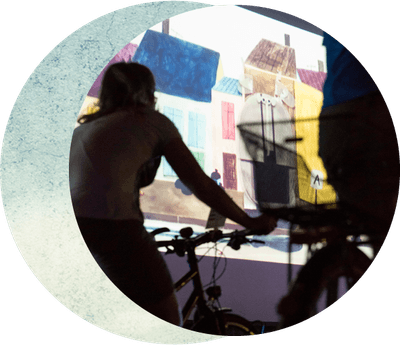
Moviemiento
Active last verified 2026-09Curated the 2018 KLAK tour and still books a ten-bike KLAK system
-
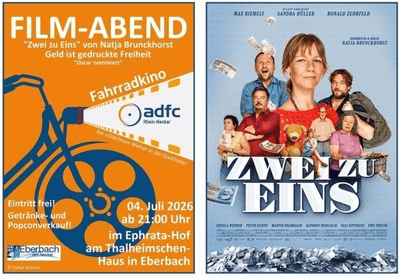
ADFC Rhein-Neckar mobile Fahrradkino
Active last verified 2026-09A regional Fahrradkino of the kind that took over demand after the project ended
Sources
- [1]Solare Zukunft e.V., Technisches Manual Fahrradkino, 20.12.2018fahrradkino.org
- [2]klimaschutz.de (NKI) — KLAK KlimaAktionsKino project pagewww.klimaschutz.de
- [3]Helmholtz-Gymnasium Karlsruhe — Fahrradkino school report (event 12.01.2026)www.helmholtz-karlsruhe.de
- [4]Landkreis Ludwigsburg — Fahrradkino press release (2024-11-29)www.landkreis-ludwigsburg.de
- [5]UfU e.V. — KLAK KLimaAktionsKinowww.ufu.de
- [6]Solare Zukunft e.V.www.solarezukunft.org
- [7]Vélorution (Zürich) — VéloKinovelorution.ch
Comments
Comments are reviewed before they appear. How comments and contributions are reviewed