Wuhan University Bicycle-Generator Study
- Split from an aggregated directory row
- Historical only
Websitehttp://www.xml-data.cn/WHDXXBGXB/html/0e5fe056-d344-44e0-959b-51fbf739f939.htm
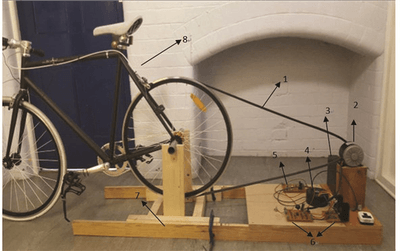
A 2016 Wuhan University study built and instrumented a complete pedal-to-projector energy chain. It measured about 58% generation efficiency at a normal cadence against an average projector load of 58.2 W.
Key facts
“自行车动力发电的效率为58%左右”
Translation: The efficiency of bicycle-powered generation is approximately 58 percent.
Engineers at Wuhan University published the study in the Journal of Wuhan University (Engineering Science), motivated by pedal-powered open-air cinema for power-free settings such as fieldwork sites and mountain regions 1. A single-speed bicycle drove a brushed DC motor by belt; the motor charged a lead-acid battery through overcharge and deep-discharge protection, and a square-wave inverter fed the projector from the battery 1. The paper keeps measured results distinct from theoretical ones throughout. Its six authors are Huai Qing, Ding Hua, Lu Hanqing, Wang Junyao, Muhammad Arslaan Ashfak and Fernando Schlindwein, the last credited to the University of Leicester 1. No audience, tour or successor equipment is documented.
Specifications
| Field | Value | Confidence | Sources |
|---|---|---|---|
| Rear wheel diameter | 660 mm | Documented | 1 |
| Belt step-up ratio | 82.5:1 theoretical | Documented | 1 |
| Generator motor | 24 V brushed DC, 250 W rated at 2,750 rpm | Documented | 1 |
| Generation efficiency | about 58 % (at normal cadence, 60–70 rpm) | Measured | 1 |
| Battery | 12 V / 22 Ah lead-acidFitted with overcharge and deep-discharge protection. | Documented | 1 |
| Charge time to quasi-saturation | about 0.5 h (to 95% of maximum voltage) | Measured | 1 |
| Inverter | CD4047-based 50 Hz square-wave, 12 V to 230 V | Documented | 1 |
| Transformer efficiency | 90.28 % (measured at low power) | Measured | 1 |
| Average projector draw | 58.2 W | Measured | 1 |
| Runtime per full charge | 45 minutes | Measured | 1 |
| Automatic cutoff | Below 100 V supply voltageThe paper states the projector stops automatically when the voltage falls below 100 V; it does not name the node measured, and the battery bus is 12 V. | Documented | 1 |
| Audio | not disclosedThe paper documents no separate audio system. | Not disclosed | 1 |


Related
-
China's Rural 8.75 mm Pedal-Projection Network
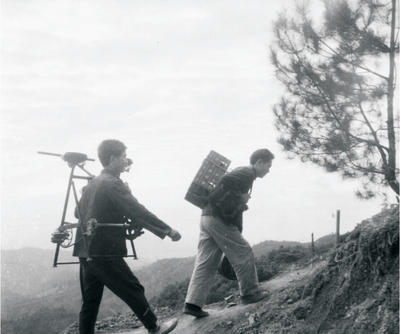
Historical last verified 2026-09The historical direct-drive predecessor this study's measured energy balance closely echoes, sixty years apart
-
Open Air Cinema ("Cinebike")
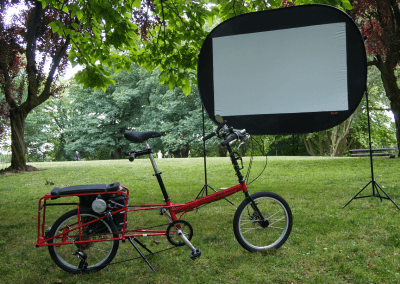
Historical last verified 2026-09The field's other fully documented single-rider build, using a direct-DC rather than battery-AC architecture
-
Low-tech Magazine — Household Bike Generator
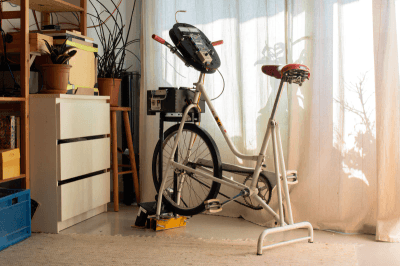
Historical last verified 2026-09The only other fully measured pedal-generator dataset in the field, from a household rather than academic build
No location documented — this entry has no map pin.
Sources
- [1]Journal of Wuhan University (Engineering Science), '自行车动力发电系统分析', 2016www.xml-data.cn
Comments
Comments are reviewed before they appear. How comments and contributions are reviewed