
Low-tech Magazine — Household Bike Generator
- Open manual source
- Split from an aggregated directory row
Websitehttps://solar.lowtechmagazine.com/2022/03/how-to-build-a-practical-household-bike-generator/
No location documented — this entry has no map pin.
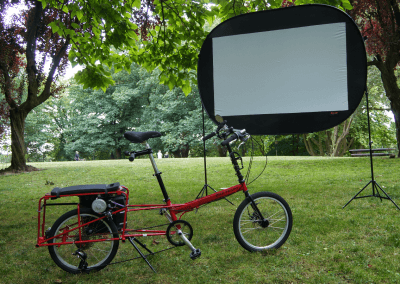
Low-tech Magazine published a measured, open build guide for a household bicycle generator on 6 March 2022. The same generator ran a video projector directly from its regulated 12-volt circuit, with no battery in between.
Key facts
“Our generator achieves its maximum efficiency (75-78%) at a power output of more than 6A (72W). Efficiency decreases when you produce less power: it drops to 60% at 3A and less than 45% at 2A.”
The solar-powered publication on low-energy technology run by Kris De Decker compiled the loss-budget figures still cited across the field in a 2011 article, "Bike powered electricity generators are not sustainable" 3,2; the 2022 guide turned that reading into an instrumented build 1. A 1950s exercise bike with a flywheel turns a permanent-magnet DC motor through a friction drive, and a control panel of buck/boost circuits distributes the output to USB, battery-charging and inverter circuits 1. The guide is a household energy project, about lighting a home, boiling water and running small appliances from pedalling. It is in this directory because its output and efficiency were read at the generator with volt/ampere meters, and because, with the KLAK manual, the Bespoke Gear no-weld plans and the Cinebike build log, it is one of the four open manuals here from which a system can be built.
Specifications
| Field | Value | Confidence | Sources |
|---|---|---|---|
| Generator type | 12V/24V permanent-magnet brushed DC motor (Ampflow Pancake Motor P40-250) | Documented | 1 |
| Generator rated power | up to 250 W (150–250 W typical range recommended) | Documented | 1 |
| Control-panel outputs | 5 V USB, 12 V, 14.4 V battery charging and 220 V AC via inverter, plus one unregulated circuitBuck/boost converter circuits on the build's own control panel. | Documented | 1 |
| Sustained output (moderate effort) | 45–75 W | Measured | 1 |
| Burst output (short, heavy effort) | about 100 W | Measured | 1 |
| Generator efficiency, above 72 W (6 A) | 75–78 % | Measured | 1 |
| Generator efficiency, at 36 W (3 A) | 60 % | Measured | 1 |
| Generator efficiency, at 24 W (2 A) | below 45 % | Measured | 1 |
| Friction-drive coupling loss | about 15 % (average extra loss) | Measured | 1 |
| Pedal input needed for 100 W output | at least 150 W (accounting for generator and friction-drive losses)The authors' own derivation from their measured efficiencies, not a separately instrumented figure. | Estimated | 1 |
| Output after drivetrain cleaning/oiling | doubledPower production doubled after the bicycle's drivetrain was thoroughly cleaned and oiled. | Measured | 1 |
| 2011 loss budget (chained AC architecture) | 42–67.5 % total electrical loss (32.5–58% net efficiency)Generator 10–20%, voltage regulator ~25%, battery 10–35%, converter 5–15%; a literature-sourced cascade, not this build's own measurement. | Documented | 2,3 |
Technology
The guide specifies a brushed permanent-magnet motor because brushless types need too high a rotation speed 1. Efficiency falls steeply as the load drops, so a generator turned gently by several casual riders can sit at the worst point of its own curve 1.


In their own words
"We obtained roughly 100 watts (12V, 8-9A) of power during a short and heavy workout. During a moderate effort – which we can sustain for a longer time – power production is between 45 and 75 watts." 1
Related
-
Bespoke Gear / Renewable Energy Innovation
Active last verified 2026-09Another of the field's four verified open-manual entry points, for the generator stand rather than the generator itself
-

Explainer
About Fifty Watts: What a Person Can Pedal
This build's measured 45–75 W output is a primary data point behind the site's per-rider wattage explainer
-

University Reference Builds — Leicester and Sheffield/EWB
Historical last verified 2026-09Split from the same aggregated directory row; comparable university and DIY reference builds
-
Explainer
Roller, Hub, Belt, Rack: Four Coupling Families
The explainer on drive types and generator efficiency draws directly on this build's measured curve
Sources
- [1]Low-tech Magazine — How to Build a Practical Household Bike Generator (2022)solar.lowtechmagazine.com
- [2]Low-tech Magazine, 'Bike powered electricity generators are not sustainable'www.lowtechmagazine.com
- [3]Low-tech Magazine — Bike-powered electricity generators are not sustainable (2011)solar.lowtechmagazine.com
Comments
Comments are reviewed before they appear. How comments and contributions are reviewed