
Explainer · How it works
Roller, Hub, Belt, Rack: Four Coupling Families
Twelve documented systems use one of four couplings: a roller pressed against the rear tyre, a hub built as the generator, a chain or belt, or Cinécyclo's rotating luggage rack. Rollers are the most common; chain and belt drives reach the highest documented efficiency.
Rear-wheel friction roller
Among the documented systems, the most common coupling presses a small roller against the rear tyre. KLAK's ten trainers use a friction roller, "Reibrolle," tensioned by hand with an adjusting screw, "Stellschraube" 10. Oekotrainer's generator itself is the roller, pressed against the tyre by a knurled screw 11. Cinécyclo's touring kit uses a roller, "galet," "en pression sur le pneu" — pressed against the tyre 9. Rock the Bike's Roll-Up stand is also a friction-roller unit: a 6-inch composite roller that doubles as a flywheel, manufacturer-rated at 300 W continuous, which the product page calls "very challenging for most pedalers to sustain" 6. Low-tech Magazine puts friction drives at 80–90% efficiency, with about 15% average additional loss measured on its own 2022 build, worsening at low tyre pressure 1,2. Treaded mountain-bike tyres are excluded for noise, the roller's pressure has to match the load it drives, and bicycles with hub gears or thru-axles need adapters or do not fit 11,10.
Specifications
| Field | Value | Confidence | Sources |
|---|---|---|---|
| Friction-roller coupling efficiency | 80–90 %Low-tech Magazine, citing bicycle-engineering literature; degrades further at low tyre pressure. | Documented | 1 |
| Friction-drive extra loss, measured build | about 15 % average additional lossLow-tech Magazine's own 2022 instrumented build. | Measured | 2 |
| Chain or belt-drive efficiency | up to 98 % | Documented | 1 |
| Chain-drive efficiency, best case measured | 98.6 %Johns Hopkins University / Spicer et al. tests; worst case in the same tests was 81%. | Measured | 3 |
| Chain-drive efficiency, worst case measured | 81 % | Measured | 3 |
| Wuhan University reference design, belt step-up ratio | 82.5:1 theoretical, from a 660 mm rear wheel | Documented | 4 |
| Rock the Bike Generator Pro output | nominally 24 V DC (rectified from 3-phase AC)Voltage is "pegged to the load you connect," per the manufacturer. | Documented | 5 |
| Rock the Bike Roll-Up roller | 6-inch (152 mm) composite roller, doubles as flywheel | Documented | 6 |
| Rock the Bike Roll-Up continuous rating | 300 W continuousThe product page itself calls 300 W sustained "very challenging for most pedalers to sustain." | 6 | |
| Commercial belt-from-rim efficiency claim | up to 40 % advantage over a roller systemVendor claim; no published methodology. | 7 | |
| Oekotrainer generator output | 0–50 V DC, 36 A max, up to 85 % efficiencyThe word "permanent magnet" is not published; only this speed-dependent behaviour is. | 8 | |
| Cinécyclo roller material, step-up ratio, cadence band | not disclosedThe association explicitly declines technical disclosure. | Not disclosed | 9 |
Hub generator wheel
A second family builds the generator into the wheel and touches no tyre. Rock the Bike's Generator Pro is a fixed-gear bicycle whose dedicated rear wheel contains a large brushless hub generator; the manufacturer describes the hub's mass as a flywheel that smooths pedal strokes, and a "Rectifier Cable" converts the hub's three-phase alternating output to a nominal 24 V direct current 5. The same generator wheel is sold separately as a retrofit rear wheel 12. Vienna's CycleCinemaClub is a variant of this family: converted electric bicycles whose hub motors run backward as generators 13.

Belt or chain
The third family reaches the highest documented efficiency — up to 98%, with a measured best case of 98.6% and a worst case of 81% in tests run for Johns Hopkins University 1,3. The Wuhan University reference design drove its generator by belt from a 660 mm rear wheel at a theoretical 82.5:1 step-up ratio 4, and a commercial belt-from-rim generator claims up to a 40% efficiency advantage over roller systems, with no published methodology 7. The bicycle has to be modified or dedicated to the purpose, which is why belt and chain couplings appear in academic and DIY builds rather than in rigs that must accept any audience bicycle.
Rotating rack
Cinécyclo's "porte-bagage rotatif" is a luggage rack mounted on the rear axle that pivots down at night to become the stationary stand, keeping the whole generation kit on one touring bicycle 9. No patent for the rack exists in any located register, and the association declines to publish roller material, step-up ratio or cadence band, so any such figures circulating elsewhere are unverified 9.
What the choice costs
A roller fits almost any bicycle without modification but wears tyres, needs noise and pressure management, and slips on a soft tyre. A hub generator wears nothing and needs no adjustment but requires a dedicated wheel or bicycle and costs more. A belt or chain gives the highest efficiency of the four, but only after the bicycle itself has been changed. A thirteenth system, EnergoRower, does not say how its stand couples to the bicycle. The procurement question that follows is which wheel sizes, axle types and tyres a stand accepts, and what happens when an audience member's own bicycle does not fit.
Systems that show this
-
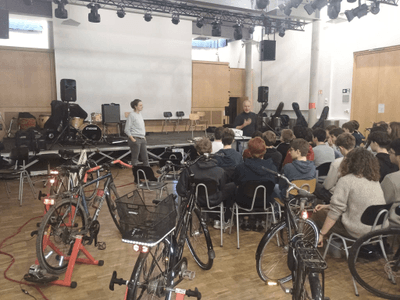
KLAK / Solare Zukunft e.V.
Active last verified 2026-09Germany · School programme
-
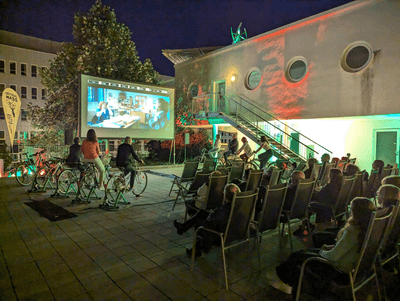
Oekotrainer.de
Active last verified 2026-09Germany · Equipment supplier
-
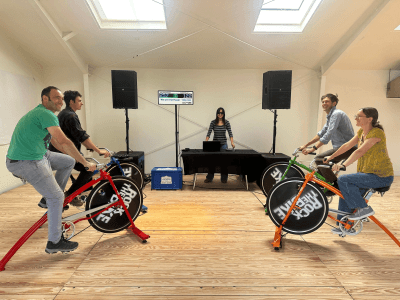
Rock the Bike
Active last verified 2026-09United States · Equipment supplier
-
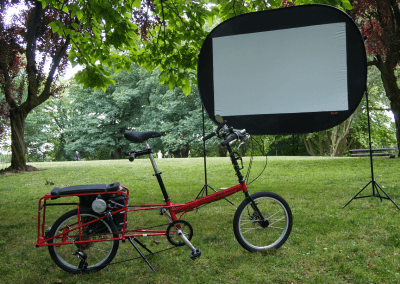
Open Air Cinema ("Cinebike")
Historical last verified 2026-09United States · Research or reference build
Read next
-
Explainer
Buffers: Seconds or Hours
How it works
-
Explainer
About Fifty Watts: What a Person Can Pedal
Numbers
-
Explainer
Live-Wire, Battery-Buffered, Unbuffered: Three Topologies
How it works
-
In-depth feature
One bike, one rider, 196 watt-hours: the Cinebike
People
Sources
- [1]Low-tech Magazine, 'Bike powered electricity generators are not sustainable'www.lowtechmagazine.com
- [2]Low-tech Magazine — How to Build a Practical Household Bike Generator (2022)solar.lowtechmagazine.com
- [3]Johns Hopkins University news release, 1999pages.jh.edu
- [4]Journal of Wuhan University (Engineering Science), '自行车动力发电系统分析', 2016www.xml-data.cn
- [5]Rock the Bike blog — Generator Pro (2016)rockthebike.com
- [6]Rock the Bike, 'Roll Up Generator Stand' product pagerockthebike.com
- [7]Pedal Power Generator, 'Belt Drive 300W Bike Generator + Stand'www.pedalpowergenerator.com
- [8]oekotrainer.de — FAQoekotrainer.de
- [9]Cinécyclo, 'Pôle technique'www.cinecyclo.com
- [10]Solare Zukunft e.V., Technisches Manual Fahrradkino, 20.12.2018fahrradkino.org
- [11]Oekotrainer — shop/descriptionoekotrainer.de
- [12]Rock the Bike blog, 'Generators available from Rock The Bike'rockthebike.com
- [13]Die Presse — Kino aus den Wadeln (2017)www.diepresse.com
Comments
Comments are reviewed before they appear. How comments and contributions are reviewed