
Explainer · How it works
Buffers: Seconds or Hours
This page explains how documented systems work. It is not a construction manual, and it gives no build instructions.
A buffer covers the gap between what the riders produce and what the projector draws, including the moment a rider steps off. Ultracapacitor buffers bridge seconds to a few minutes; LiFePO4 battery buffers bridge hours; Cinécyclo's hybrid holds about 40 to 55 seconds.
Two kinds of storage
A buffer stores energy electrostatically, in an ultracapacitor, or electrochemically, in a battery; a few systems carry a little of both. The chemistry sets the bridge time — how long the picture survives without pedalling — and the safety profile of the whole system.
Specifications
| Field | Value | Confidence | Sources |
|---|---|---|---|
| Ultracapacitor coulombic efficiency | greater than 99 %Manufacturer datasheet figure for ultracapacitor cells generally, not a measurement of any specific pedal-cinema system. | Documented | 1 |
| Ultracapacitor cycle life | 500,000 to over one million duty cyclesManufacturer datasheet figure for the cell class, presented as category context. | Documented | 2 |
| Ultracapacitor usable energy | approximately 75 % of stored energy, discharging from rated to half-rated voltageExplains why ultracapacitor bridges run seconds to minutes, not hours. | Documented | 3 |
| Rock the Bike Pedal Power Utility Box bridge | 2–5 minutes, depending on consumption | 4 | |
| Cinécyclo hybrid buffer | about 40 secondsLes Échos, 2025. | Operator-stated | 5 |
| Cinécyclo hybrid buffer, alternate figure | 55 secondsADRC sector guide, 2025. | Operator-stated | 6 |
| KLAK central-unit battery chemistry | LiFePO4Capacity in watt-hours is not disclosed. | Documented | 7 |
| Oekotrainer buffer capacity | 12.8 V / 100 Ah / 1,280 Wh (LiFePO4) | Documented | 8 |
| Rock the Bike Event Power Box capacity | 2.5 or 5 kWhOnly the 5 kWh option is published as a capacity; the standard 2.5 kWh is implied by the page's own worked example, not printed. Battery chemistry and bus voltage are not published either. | 9 | |
| KLAK central-unit output | 230 V AC / 50 Hz, up to 500 W | Documented | 7 |
| LiFePO4 thermal-runaway onset | near 270 °CVendor-published comparison, consistent with the technical literature. | Documented | 10 |
| NMC thermal-runaway onset | 150–210 °C | Documented | 10 |
| LiFePO4 cycle life | 4,000–10,000 cycles, against 1,500–3,000 for NMC | Documented | 10 |
| Karlsruhe school event auxiliary-battery draw | about 30 %12 January 2026; cause stated as bikes not continuously occupied late in the film. | Operator-stated | 11 |
| Measured generator efficiency by load point | 75–78% above 72 W, 60% at 36 W, below 45% at 24 WLoad-dependent; an oversized generator on a small load idles in its lossy region. | Measured | 12 |
| Schottky diode rating, Low-tech Magazine build | 10 A, against an 8–9 A maximum production current | Documented | 12 |
Ultracapacitors: seconds to minutes
Ultracapacitor cells as a class are manufacturer-documented at greater than 99% coulombic efficiency and 500,000 to over one million duty cycles, with charge times measured in seconds 1,2. Those figures describe the cell technology, not any pedal-cinema system: no operator using ultracapacitors has published capacitance or in-system efficiency figures of its own. The limit is energy, not power. About 75% of stored energy is usable when discharging from rated voltage to half-rated voltage 3, which is why ultracapacitor bridges run seconds to minutes rather than hours. Rock the Bike's Pedal Power Utility Box states "a 2–5 minute buffer of power (depending on consumption levels)" 4. Cinécyclo's hybrid kit has carried supercapacitors since 2016 "to reduce battery use to a minimum" and reports about 40 seconds of autonomy in one 2025 account and 55 seconds in another 5,6.

LiFePO4 and NMC: hours
Battery-buffered systems trade that speed for hours of ride-through. KLAK's central unit runs on a lithium iron phosphate (LiFePO4) battery whose watt-hour capacity is not disclosed; its output is 230 V AC up to 500 W 7. Oekotrainer's rental set specifies its buffer exactly — 12.8 V, 100 Ah, 1,280 Wh, also LiFePO4 8. Rock the Bike's Event Power Box is rated at 2.5 or 5 kWh, with chemistry and bus voltage unpublished 9. LiFePO4's documented thermal-runaway onset sits near 270°C, against 150–210°C for lithium nickel manganese cobalt oxide (NMC) cells, and its cycle life is 4,000–10,000 against NMC's 1,500–3,000 10. Where the chemistry is published, the documented battery-buffered systems use LiFePO4, not NMC 7. Either chemistry still needs a functioning battery management system; a UK coroner's report made that point in fatal terms for an unmanaged e-bike pack 13.

Buffer size and swap cadence
A large buffer lets a screening run on with the bicycles empty; a small one keeps the effort visible but exposes every slow changeover. At Karlsruhe's school screening on 12 January 2026, students rotated every five to fifteen minutes under a live wattage display, and the system still drew about 30% of its auxiliary battery, mainly because the bikes were no longer continuously occupied toward the end of the film 11. The buffer also has to suit the generator's efficient band: one instrumented build reached 75–78% efficiency only above 72 W of output, falling to 60% at 36 W and below 45% at 24 W, so an oversized generator on a small load idles in its lossy region whatever the buffer behind it 12. Berlin's ufaFabrik removes the buffer altogether and raises the resistance on the remaining bikes when a rider drops out 14.
Fielded protections and recommendations
Two protections are documented as fielded practice. Reverse-current isolation: Low-tech Magazine's manual warns that "without a diode, the battery could power the generator (and turn the pedals) instead of the other way around," and specifies a Schottky diode rated above the expected current — 10 A against an 8–9 A maximum 12. Supervision: KLAK's central unit shuts down after ten minutes without pedalling and carries state-of-charge alarms 7. Two further measures are engineering recommendations rather than documented pedal-cinema practice: pre-charging or current-limiting an ultracapacitor bank, because a discharged capacitor "appears as a short circuit" to whatever is charging it, and ideal-diode controllers as a lower-loss alternative to a simple diode in a multi-bike array 15,16. No pedal-cinema hardware documented here has either measure built in; both belong on a design review with a qualified engineer rather than on a parts list.
What to ask
Ask for the bridge time in writing and compare it with the slowest realistic rider swap, not the best case. Ask which chemistry is inside and whether it carries a working battery management system. Ask what happens to the picture when the buffer runs low — a fade, an alarm or a hard cut.
Systems that show this
-
Rock the Bike
Active last verified 2026-09United States · Equipment supplier
-
KLAK / Solare Zukunft e.V.
Active last verified 2026-09Germany · School programme
-
Oekotrainer.de
Active last verified 2026-09Germany · Equipment supplier
-
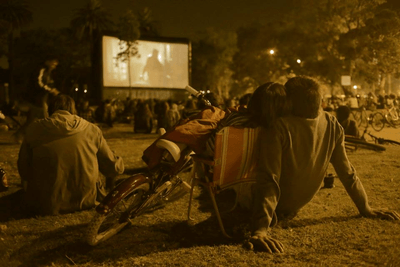
Efecto Cine / Efecto Pedal
Active last verified 2026-09Uruguay · Commercial hire
Read next
-
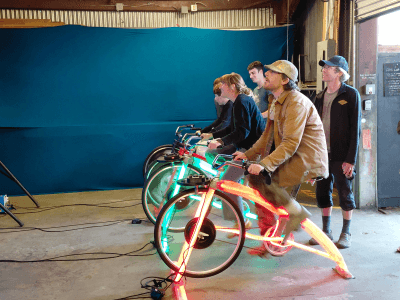
Explainer
Live-Wire, Battery-Buffered, Unbuffered: Three Topologies
How it works
-
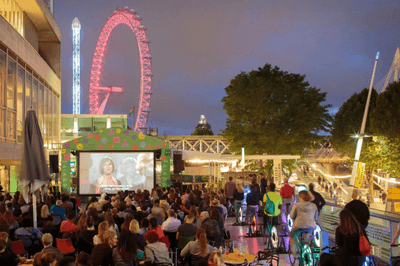
Explainer
Safety on the DC Side and the AC-Only Standard
Safety
-
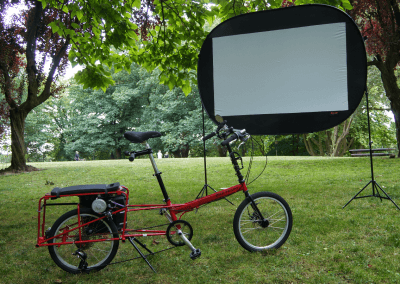
Explainer
Roller, Hub, Belt, Rack: Four Coupling Families
How it works
Sources
- [1]Maxwell Technologies — Top 10 Reasons for using Ultracapacitorswww.aepint.nl
- [2]Maxwell BCAP0010 BOOSTCAP datasheetwww.nooelec.com
- [3]Maxwell Technologies, 'Design Considerations for Ultracapacitors'maxwell.com
- [4]Rock the Bike — Pedal Power Utility Box (blog, 2011, current)rockthebike.com
- [5]Les Échos PME — L'échappée belle de Cinécyclo (2025)www.lesechos.fr
- [6]ADRC — Guide cinémas verts et durables (2025)adrc-asso.org
- [7]Solare Zukunft e.V., Technisches Manual Fahrradkino, 20.12.2018fahrradkino.org
- [8]Oekotrainer — shop/descriptionoekotrainer.de
- [9]Rock the Bike — Event Power Box product pagerockthebike.com
- [10]BSLBATT — LFP vs NMC technical comparisonbslbatt.com
- [11]Helmholtz-Gymnasium Karlsruhe — Fahrradkino school report (event 12.01.2026)www.helmholtz-karlsruhe.de
- [12]Low-tech Magazine — How to Build a Practical Household Bike Generator (2022)solar.lowtechmagazine.com
- [13]Courts and Tribunals Judiciary — Bobby Lee: Prevention of future deaths report (2024)www.judiciary.uk
- [14]ufaFabrik Berlin — Pedal Power Cinemawww.ufafabrik.de
- [15]PEC Components — Inrush Current Control / Precharge Resistorswww.peccomponents.com
- [16]AnyPCBA — Precharge Resistor guidewww.anypcba.com
Comments
Comments are reviewed before they appear. How comments and contributions are reviewed