
Explainer · How it works
Live-Wire, Battery-Buffered, Unbuffered: Three Topologies
Documented pedal cinemas use one of three topologies: live-wire (an ultracapacitor bridges seconds to minutes and the picture fades if pedalling stops), battery-buffered (a LiFePO4 pack runs the projector for hours), or unbuffered (Berlin's ufaFabrik raises the resistance on the remaining bikes when a rider steps off).
Live-wire, ultracapacitor-bridged
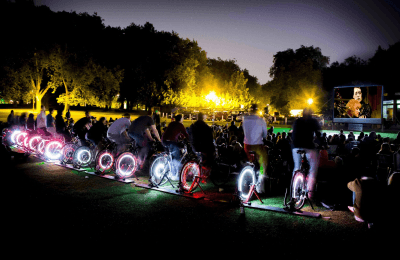
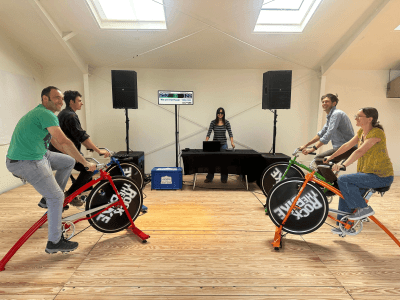
The projector runs on what the riders produce at that moment. Electric Pedals of London prints on its hire pages: "All electricity is generated live by the riders. No mains power. No stored battery energy." 13 Its backpack "OWL" cinema, built for a Malawi conservation tour that reached over 14,000 people in six weeks, uses "ultra capacitor technology rather than batteries, making the system 100% pedal-powered" 1. Rock the Bike's Pedal Power Utility Box states its bridge time in writing — an ultracapacitor "lasting a few minutes," specifically "a 2–5 minute buffer of power (depending on consumption levels)"; a 60–120 second figure that circulates elsewhere appears in no Rock the Bike document 2. Uruguay's Efecto Pedal runs the principle at larger scale: ten hub-motor bicycles plus up to twelve docking stations for the audience's own bikes, buffered in an ultracapacitor bank, with an operator-stated minimum of about 1,300 W for projector, sound and the inflatable screen's blower together 3. When pedalling stops, the image fades within the capacitor's bridge time; the fade keeps the audience's effort visibly tied to the picture.
Specifications
| Field | Value | Confidence | Sources |
|---|---|---|---|
| OWL backpack cinema roadshow reach | over 14,000 people reached in six weeks (Malawi launch tour)Optoma case study; deployment year not printed. | Documented | 1 |
| Pedal Power Utility Box ultracapacitor bridge | 2–5 minutes, depending on consumptionCorrects a widely circulated 60–120 s figure that appears in no Rock the Bike document. | 2 | |
| Efecto Pedal minimum system power | at least 1,300 W for projector, sound and screen-inflation blower togetherSingle source; monitored by a real-time LED voltmeter, not independently metered. | Operator-stated | 3 |
| KLAK central unit maximum output | 230 V / 50 Hz, up to 500 W | Documented | 4 |
| KLAK projector draw | 340 W | Documented | 4 |
| Oekotrainer buffer capacity | 12.8 V / 100 Ah / 1,280 Wh (LiFePO4) | Documented | 5,6 |
| Oekotrainer inverter rating | 1,000 W max / 600 W recommended continuous | Documented | 5,6 |
| CicloCinema buffer capacity | not disclosedThe project names only "an inverter with battery"; voltage and Wh are not published. | Not disclosed | 7,8 |
| Cinécyclo hybrid buffer, press-reported | about 40 seconds of autonomyLes Échos, 2025. | Operator-stated | 9 |
| Cinécyclo hybrid buffer, sector-guide figure | 55 seconds of autonomyADRC sector guide, 2025; the two figures are both cited rather than reconciled. | Operator-stated | 10 |
| Rock the Bike Event Power Box capacity | 2.5 or 5 kWhOnly the 5 kWh option is published as a capacity; the standard 2.5 kWh is implied by the page's own worked example (a 300 W PA for about eight hours), not printed. Battery chemistry and bus voltage are not published either. | 11 | |
| Rock the Bike Event Power Box inverter limit | 1,500 WProduct-page rating; no independent measurement exists. | 11 | |
| ufaFabrik pedal-cinema fleet | 10 bikes on dynamo trainers, running since 2012 | Documented | 12 |
Battery-buffered AC
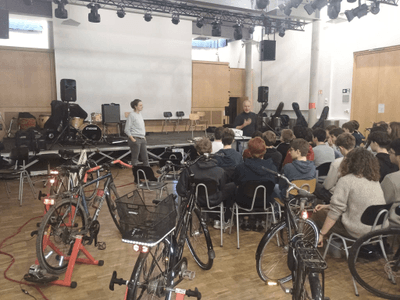
KLAK's central unit supplies 230 V / 50 Hz AC up to 500 W from a lithium iron phosphate (LiFePO4) battery that ten roller-trainer riders keep topped up; the projector alone takes 340 W 4. Oekotrainer's rental "Fahrradkino" set buffers into a 12.8 V / 100 Ah / 1,280 Wh LiFePO4 pack and inverts through a 1,000 W unit recommended for continuous loads up to 600 W 5,6. CicloCinema's touring rig carries "an inverter with battery" of undisclosed capacity 7,8. The battery is the design's purpose: a screening that continues when one rider tires, and survives several minutes with every bike empty.

Hybrid: a reserve for the swap
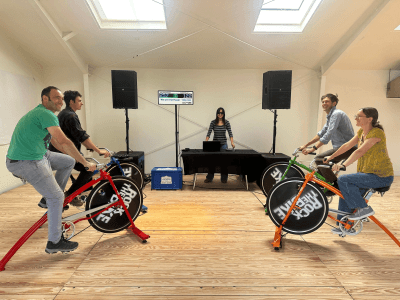
Cinécyclo sits between the two. Its CinécycloBox has carried supercapacitors since 2016 "to reduce battery use to a minimum," with a small lithium reserve reported at about 40 seconds by a 2025 business paper or 55 seconds by a 2025 French rural-cinema sector guide 9,10 — enough to cover one rider swapping for the next, not an inattentive audience. Rock the Bike sells both philosophies side by side, the ultracapacitor-only Utility Box and a battery-based Event Power Box rated at 2.5 or 5 kWh behind a 1,500 W inverter, so a buyer can choose the trade-off rather than inherit whichever one a single vendor sells 2,11.
Unbuffered: ufaFabrik
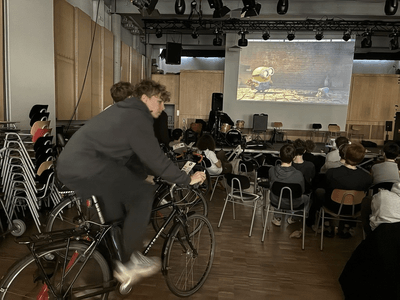
Berlin's ufaFabrik has run its pedal cinema since 2012 on ten bikes wired to dynamo trainers, with no battery and no ultracapacitor anywhere in the system. When a rider dismounts, the system raises the pedalling resistance on the nine remaining bikes, so the power reaching the projector does not dip 12. It is the only pedal cinema documented here built this way: continuity comes from the fleet's own reserve of effort rather than from stored charge, at the cost of a resistance step every rider feels during a changeover.
Comparing quotes
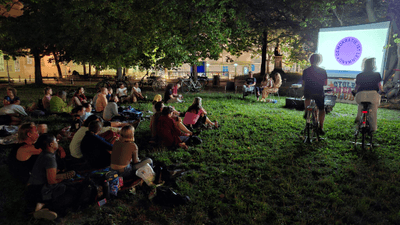
Live-wire systems remove lithium from the venue and hand continuity to rider discipline; battery systems buy continuity at the cost of managing a battery; the event's purpose, not build difficulty, decides between them. The comparable figure is a swap-cadence guarantee — the bridge time against the slowest plausible changeover between riders. Cinécyclo's 40–55 seconds covers a brisk swap; Rock the Bike's 2–5 minutes tolerates a clumsy one. Two quotes cannot be compared until the buyer has decided, in writing, whether the screening may stop.
Systems that show this
-
Electric Pedals
Active last verified 2026-09United Kingdom · Commercial hire
-
KLAK / Solare Zukunft e.V.
Active last verified 2026-09Germany · School programme
-
Rock the Bike
Active last verified 2026-09United States · Equipment supplier
-
CycleCinemaClub
Active last verified 2026-09Austria · Nonprofit association
-
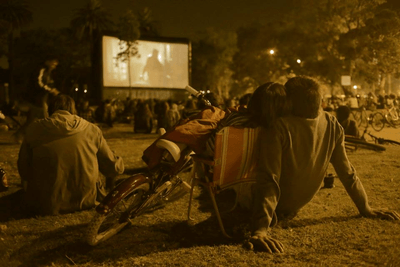
Efecto Cine / Efecto Pedal
Active last verified 2026-09Uruguay · Commercial hire
Read next
-
Explainer
Buffers: Seconds or Hours
How it works
-

Explainer
About Fifty Watts: What a Person Can Pedal
Numbers
-
In-depth feature
The cinema that published its wiring: KLAK / Solare Zukunft
People
-
In-depth feature
"The people are the batteries": Electric Pedals
People
-
In-depth feature
An ultracapacitor box and a battery box: Rock the Bike
How it works
Sources
- [1]Optoma Europe case study #310 — Pedal powered cinema bringing films to remote areaswww.optomaeurope.com
- [2]Rock the Bike — Pedal Power Utility Box (blog, 2011, current)rockthebike.com
- [3]Presidencia de la República Uruguay — Efecto Pedal launch (2014)www.gub.uy
- [4]Solare Zukunft e.V., Technisches Manual Fahrradkino, 20.12.2018fahrradkino.org
- [5]Oekotrainer — shop/descriptionoekotrainer.de
- [6]Oekotrainer Gebrauchsanleitung 5.0, 27 Mar 2024oekotrainer.de
- [7]CicloCinema, 'The pedal powered nomadic cinema'ciclocinema.org
- [8]CicloCinema — live homepage (2026)ciclocinema.org
- [9]Les Échos PME — L'échappée belle de Cinécyclo (2025)www.lesechos.fr
- [10]ADRC — Guide cinémas verts et durables (2025)adrc-asso.org
- [11]Rock the Bike — Event Power Box product pagerockthebike.com
- [12]ufaFabrik Berlin — Pedal Power Cinemawww.ufafabrik.de
- [13]Electric Pedals — Large/Small Bicycle Powered Cinema hire pageswww.electricpedals.com
Comments
Comments are reviewed before they appear. How comments and contributions are reviewed