
In-depth feature · People
The cinema that published its wiring: KLAK / Solare Zukunft
A German climate-education project funded from 2016 to 2019 published a full technical manual for its ten-bike, battery-buffered cinema; two school events in 2024 and 2026 reported what the bikes delivered.
Ten roller trainers feed a central unit with a LiFePO4 buffer that supplies up to 500 watts at 230 V and shuts itself off after ten minutes without pedalling. KLAK's technical manual, dated 20 December 2018, is the most complete pedal-cinema build document located in this corpus.
“Sonst werden die Akkus schnell entladen, da der Beamer 340 Watt an elektrischer Leistung aufnimmt.”
Translation: Otherwise the batteries are quickly discharged, because the projector draws 340 watts of electrical power.
“Alle zehn 'menschlichen Kleinkraftwerke' sollten im grünen Bereich fahren. … Der gelbe Bereich bedeutet: Teil dir deine Kräfte ein. Der rote Bereich bedeutet: Da geht noch mehr.”
Translation: All ten 'human mini power plants' should ride in the green zone. … The yellow zone means: pace yourself. The red zone means: there is more in you.
“Trotz des großen Engagements reichte die selbst erzeugte Energie nicht vollständig aus. Rund 30 % des zusätzlichen Akkus wurden benötigt. Ursachen dafür waren vor allem, dass die Fahrräder gegen Ende nicht mehr dauerhaft besetzt waren.”
Translation: Despite the great commitment, the self-generated energy was not fully sufficient. Around 30% of the auxiliary battery was needed. The main cause was that the bikes were no longer continuously occupied toward the end.
A climate-education project, 2016–2019
KLAK — KlimaAktionsKino — began as a climate-education project. Solare Zukunft e.V. in Freiburg and the Berlin-based UfU e.V. ran it under Germany's National Climate Initiative from 1 May 2016 to 30 April 2019, with a grant of €634,468 2,3. The public funding carried a condition to publish how the machine worked, in enough detail for a third party to build one; the technical manual is dated 20 December 2018 and remains the current published version in 2026 1.
The project's centrepiece was the Fahrradkino-Tour 2018, sixteen cities across Germany, and complete systems were installed for six months in four selected youth hostels 2,3. After the funding ended in 2019, regional Fahrradkinos across the country took up the demand the project created 2; the Swiss Vélorution collective's VéloKino, a ten-bike battery-buffered rig in Zurich, credits "© fahrradkino.org" as its design source 6; and Solare Zukunft remains active in the school market, running the ten-bike system directly 7.
Specifications
| Field | Value | Confidence | Sources |
|---|---|---|---|
| Pedalling stations | 10 roller trainersTen ride simultaneously; the manual asks organisers to bring a pool of at least thirty people. | Documented | 1 |
| Generator rating per trainer | up to 250 W peakThe manual's design figure is an average of 50–60 W per bike, not the peak rating. | Documented | 1 |
| Per-bike average output | 50–60 W | Documented | 1 |
| Projector draw | 340 WProjector model is not disclosed in the manual. | Documented | 1 |
| Design-point generation, ten riders | 500–600 WTen riders at the manual's 50–60 W design average, against a load of 340 W plus audio and laptop. | Documented | 1 |
| Central-unit maximum output | 230 V AC / 50 Hz, 500 maximum W | Documented | 1 |
| Buffer chemistry | LiFePO4 (lithium iron phosphate)Selected, per the project's own information sheet, for its low fire risk. | Documented | 1 |
| Buffer capacity | not disclosed | Not disclosed | 1 |
| Auto-shutdown threshold | 10 minutes without pedallingAlso shuts down at 100% state of charge; warns below 20%; events should start at 60–70%. | Documented | 1 |
| Project grant | 634,468 € (funding code 03KF0034A/B, 2016–2019) | Documented | 2,3 |
| Fahrradkino-Tour 2018 | 16 cities | Documented | 2,3 |
| Ludwigsburg field output (November 2024) | about 400–500 W from 10 bikesDistrict press release; works out to roughly 40–50 W per bike with rotating schoolchildren, slightly under the manual's design point. | Operator-stated | 4 |
| Karlsruhe battery draw (12 January 2026) | about 30 % of the auxiliary batteryThe school's own report; bikes were not continuously occupied toward the end of the event. | Operator-stated | 5 |
Ten trainers, one central unit
Ten roller trainers, each with a generator whose friction roller ("Reibrolle") presses against the rear tyre on a manual adjusting screw, feed two wiring harnesses of five Anderson Powerpole connectors each — "red to red and black to black" — into a central control unit, the Zentraleinheit 1. Inside it sits a lithium iron phosphate (LiFePO4) battery, chosen, according to the project's information sheet, because "even under the most extreme conditions there is no explosion risk." The unit converts the stored energy to 230 volts at 50 hertz and supplies a fixed set of loads — projector, sound system, playback laptop — up to a ceiling of 500 watts 1. The manual gives the reason for the ceiling: connect additional consumers and "the batteries are quickly discharged, because the projector draws 340 watts of electrical power." Each trainer is rated up to 250 watts peak, but the system is designed around an average of 50 to 60 watts per rider; ten people at that average generate 500–600 watts against a load of 340 watts plus audio and laptop, a margin meant to hold the battery's charge steady while every seat is filled 1.
The central unit shuts itself off after ten minutes without pedalling, preceded by optical and acoustic warnings; it also shuts down at 100% state of charge, warns below 20%, and the manual tells organisers to start an event at 60–70% charge 1. Riders see their own effort on the screen: a colour-coded bar for each of the ten bikes runs beneath the film.
"Alle zehn 'menschlichen Kleinkraftwerke' sollten im grünen Bereich fahren. … Der gelbe Bereich bedeutet: Teil dir deine Kräfte ein. Der rote Bereich bedeutet: Da geht noch mehr." — All ten 'human mini power plants' should ride in the green zone. … The yellow zone means: pace yourself. The red zone means: there is more in you. 1
The manual describes the friction roller and its screw tensioning but does not specify what is inside the generator housing, and it does not state the LiFePO4 pack's capacity in watt-hours.

Energy flow, stage by stage1,5,4
- 10 riders, 50–60 W electrical average each (≤250 W peak per trainer)
- Roller-trainer generators (friction roller on tire, screw-tensioned)
- 2 × 5-bike Anderson Powerpole harnesses
- Zentraleinheit: charge regulation + LiFePO4 buffer battery
- Inverter, 230 V / 50 Hz, 500 W maximum
- Projector (340 W) + PA + playback laptop
Two school events, 2024 and 2026
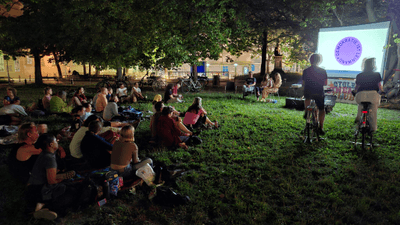
At a school event in Ludwigsburg in November 2024, the district's press release reported that the ten trainers generated "about 400 to 500 watts" with schoolchildren rotating through the seats — roughly 40–50 watts per bike, under the manual's 50–60 watt design point 4. At the Helmholtz-Gymnasium in Karlsruhe on 12 January 2026, with students swapping in every five to fifteen minutes under a live wattage display, the school's report recorded that about 30% of the auxiliary battery had been needed over the event, "mainly because the bikes were no longer continuously occupied toward the end" 5.
"Trotz des großen Engagements reichte die selbst erzeugte Energie nicht vollständig aus. Rund 30 % des zusätzlichen Akkus wurden benötigt. Ursachen dafür waren vor allem, dass die Fahrräder gegen Ende nicht mehr dauerhaft besetzt waren." — Despite the great commitment, the self-generated energy was not fully sufficient. Around 30% of the auxiliary battery was needed. The main cause was that the bikes were no longer continuously occupied toward the end. 5
The film played and the battery held the reserve it was designed to hold; the school's report documents a nominally self-sufficient ten-bike system drawing on its buffer as rider occupancy fell. Ten riders at 50–60 watts each is the figure Electric Pedals' founder cites for an average adult and the one Vienna's CycleCinemaClub designs around; what distinguishes KLAK is the published manual and the field reports of its users.


Systems that show this
-
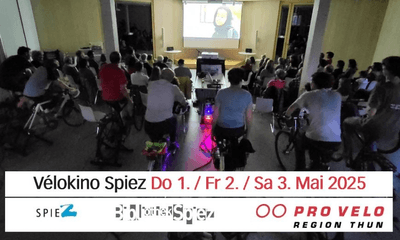
Vélorution Zürich VéloKino / velokino.ch / VCS / Pro Velo
Active last verified 2026-09Switzerland · Nonprofit association
-
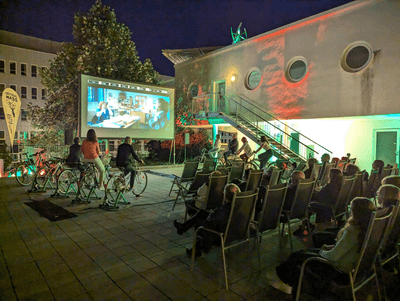
Oekotrainer.de
Active last verified 2026-09Germany · Equipment supplier
-
Moviemiento
Active last verified 2026-09Germany · Nonprofit association
-
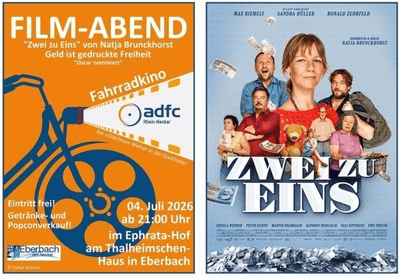
ADFC Rhein-Neckar mobile Fahrradkino
Active last verified 2026-09Germany · Nonprofit association
Read next
-
Explainer
Live-Wire, Battery-Buffered, Unbuffered: Three Topologies
How it works
-
Explainer
About Fifty Watts: What a Person Can Pedal
Numbers
-
Explainer
Manuals, Licences, Donations: How Pedal Cinema Spreads
People
-
Explainer
Reading the Numbers: Confidence Labels, Statuses and Red Flags
Numbers
-
In-depth feature
Fourteen seasons: CycleCinemaClub Vienna
People
Sources
- [1]Solare Zukunft e.V., Technisches Manual Fahrradkino, 20.12.2018fahrradkino.org
- [2]klimaschutz.de (NKI) — KLAK KlimaAktionsKino project pagewww.klimaschutz.de
- [3]UfU e.V. — KLAK KLimaAktionsKinowww.ufu.de
- [4]Landkreis Ludwigsburg — Fahrradkino press release (2024-11-29)www.landkreis-ludwigsburg.de
- [5]Helmholtz-Gymnasium Karlsruhe — Fahrradkino school report (event 12.01.2026)www.helmholtz-karlsruhe.de
- [6]Vélorution (Zürich) — VéloKinovelorution.ch
- [7]Solare Zukunft e.V.www.solarezukunft.org
Comments
Comments are reviewed before they appear. How comments and contributions are reviewed