
Explainer · Numbers
About Fifty Watts: What a Person Can Pedal
Four operators on three continents and one instrumented build put an ordinary adult's sustainable output at a pedal-cinema event at about fifty watts electrical. The planning figure is 50 W per casual rider.
The evidence range
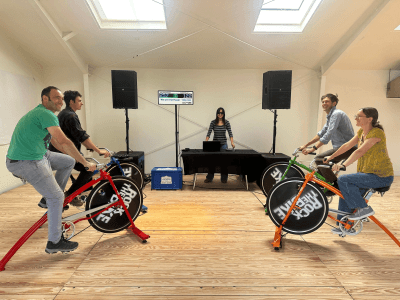
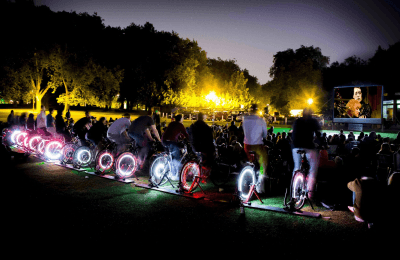
Rock the Bike, after more than a decade of pedal-powered stages in San Francisco, puts the effort per person at "approx. 50–75 Watts … the amount that an average audience member can continuously provide" 1. Electric Pedals' founder Colin Tonks puts it at 40–50 W sustained for an hour 2. The KLAK manual rates its roller trainers at up to 250 W peak per bike, averaging 50–60 W per bike over a screening 3. Low-tech Magazine's 2022 household build, measured with volt and ampere meters at the generator output, recorded 45–75 W during a moderate, sustainable effort and roughly 100 W only in a short, heavy burst 4. A UK festival-planning guide uses 60 W per adult bicycle, 30 W per child bicycle and 10 W per hand-cycle 5.
Specifications
| Field | Value | Confidence | Sources |
|---|---|---|---|
| Rock the Bike comfortable continuous output | 50–75 W electrical per rider"the amount that an average audience member can continuously provide." | Operator-stated | 1 |
| Electric Pedals (Tonks) average output | 40–50 W electrical, sustained for an hour | Operator-stated | 2 |
| KLAK roller-trainer rating | up to 250 W peak per bike; 50–60 W average per bike"bis zu 250W (im Schnitt 50–60 Watt pro Rad)." | Documented | 3 |
| Low-tech Magazine measured household build | 45–75 W sustained; approximately 100 W short heavy effortAnalogue volt/ampere meters at the generator output; non-athlete adults. | Measured | 4 |
| UK festival planning averages | 60 W adult / 30 W child / 10 W hand-cycle, per bikeIndustry planning guide, not an instrumented measurement. | Documented | 5 |
| Coggan untrained-male functional threshold power | 2.04 W/kg, about 143 W at 70 kg body mass (maximal one-hour effort) | Documented | 6 |
| Appropedia ergometer figures | 37 W indefinite; 71 W for 60–120 s; 110 W for 10 min at 80 rpmMaximal-effort laboratory tests, not voluntary event pace. | Documented | 7 |
| Published power-meter population medians | 3.8–4.95 W/kg (20-min and FTP medians)Drawn from a self-selected, trained, power-meter-owning population; would overestimate public-event capability by a factor of roughly two to four. | Uncertain | 8,9 |
| Gross metabolic efficiency range | 17–25 % | Documented | 10 |
| Zoladz et al. measured gross efficiency | 21.4 ± 1.1 % at a 120 W load17 untrained young males; peer-reviewed. | Measured | 11 |
| Metabolic cost of 100 W mechanical output | 400–500 W total (gross convention) or about 330 W additional (delta convention, ~30% efficiency)Roughly 3–4 W metabolised per watt delivered. Heat shed is 300–400 W under the gross convention, about 230 W under the delta convention. | Documented | 11,12 |
| Resting-metabolism share at a 50 W workload | about 30 % of exercise oxygen uptakeDepresses gross efficiency at the low intensities typical of cinema pedalling. | Documented | 13 |
| Attention penalty, typing-while-pedalling study | 38 ± 14 Wn = 10, recumbent ergometer, 2014. | Measured | 14 |
| Karlsruhe school event buffer draw | about 30 % of auxiliary battery consumedDespite live wattage feedback; attributed to bikes not staying continuously occupied late in the film. | Operator-stated | 15 |
| Logged single-rider session (WattsVIEW) | 65–80 W average, 150–175 W peak, about 83 minutes | Measured | 16 |
| VéloKino Zürich per-bike average | 50 W per bike (0.5 kWh/hour from 10 pedalers) | Operator-stated | 17 |
| Ludwigsburg schoolchildren event | 400–500 W total from 10 bikes | Operator-stated | 18 |
| BBC Human Power Station | up to 14 kW peak from 80 experienced cyclists (about 175 W each, peak, not sustained)Thirty of those cyclists were needed just to boil a kettle. | Documented | 19 |
| Chained AC loss budget (Low-tech Magazine, 2011) | generator 10–20%, regulator ~25%, battery 10–35%, inverter 5–15%; worst-case net about 32.5 % (30–60% of pedal power lost across a typical chain)A literature-sourced cascade, not an instrumented measurement of any one system. | Documented | 19 |
| Measured generator efficiency by load point (Low-tech Magazine, 2022) | 75–78% above 72 W output, 60% at 36 W, below 45 % at 24 WInstrumented on the magazine's own build; the curve behind Worked Example B. | Measured | 4 |
| Optoma ML750e-class projector load, for the single-rider case | 45 minimum / 65 W maximum (Bright mode)Optoma's own rating; the load a single rider has to reach. | 20 | |
| Worked Example A: AC-chain sizing | 250 W load ÷ 0.35 efficiency ≈ 714 W at the pedals ≈ 14 riders at 50 W, or ≈ 10 riders at 75 WThis report's arithmetic; load figure is the CycleCinemaClub beamer-plus-speakers class. | Estimated | 19,21 |
| Worked Example B: single-rider direct-DC sizing | pedals-to-DC net roughly 60–65%; at least 150 W pedal input needed per 100 W electrical outputDerived from Low-tech Magazine's measured generator-efficiency curve; a 60 W rider nets only about 40 W DC. | Estimated | 4 |
| Promotional claim: New Atlas Pedal-A-Watt | 100 to 320 W claimed per average adult riderResearch correction:Contradicted by every operator and measured figure in this collection; the defensible constant is 50–60 W electrical. | Promotional / press-reported — not verified | 22 |
| Promotional claim: Chris Joseph NRG | 100 to 250 W claimed per average personResearch correction:Contradicted by every operator and measured figure in this collection; the defensible constant is 50–60 W electrical. | Promotional / press-reported — not verified | 23 |
| Promotional claim: BikeCine (Brazil) | about 200 W per cyclist; roughly 2,500 W total across 12–16 stationsResearch correction:Roughly four times the 50–60 W constant documented by KLAK, Vienna's CycleCinemaClub and Electric Pedals; best read as a mechanical, short-burst figure rather than sustained electrical output.Press coverage, not independently metered. | Promotional / press-reported — not verified | 24 |
Why laboratory figures are higher
Sports-science figures measure something else. Andrew Coggan's power-profile table classes an untrained male's maximal one-hour output at 2.04 W/kg — about 143 W for a 70 kg rider 6. Ergometer tests compiled by Appropedia found untrained adult men capable of 110 W for ten minutes and 71 W for one to two minutes, with 37 W sustainable indefinitely 7. These are maximal-effort protocols, not the pace a volunteer chooses while watching a film. Published power-meter data — a 3.8 W/kg twenty-minute median and a 4.95 W/kg median threshold power among riders under thirty — comes from a self-selected population of trained, power-meter-owning cyclists and would overestimate a general audience by a factor of roughly two to four 8,9.

The metabolic cost
Gross efficiency — mechanical work out divided by total energy burned — ranges from 17% to 25%; one peer-reviewed study measured 21.4 ± 1.1% at a 120 W load in seventeen untrained young men 11. Delivering 100 W of mechanical output costs the body 400–500 W of total metabolic rate under the standard convention, 300–400 W of it shed as heat — three to four watts burned for every watt that reaches the generator 11,12. At a 50 W workload, resting metabolism alone accounts for about 30% of the oxygen the body uses 13.

Attention and rotation
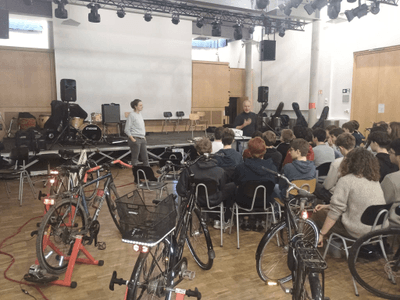
Two factors pull real audiences toward the bottom of the 40–75 W band. A 2014 study measured people typing while pedalling a recumbent ergometer at 38 ± 14 W, and an audience watching a film is the same attention-elsewhere case 14. At a school screening in Karlsruhe on 12 January 2026, the system drew down about 30% of its buffer battery despite a live on-screen wattage display, mainly because the bikes were no longer continuously occupied toward the end of the film 15. The KLAK manual's answer is procedural: ten simultaneous riders drawn from a group of at least thirty, rotating every few minutes 3.
Logged events
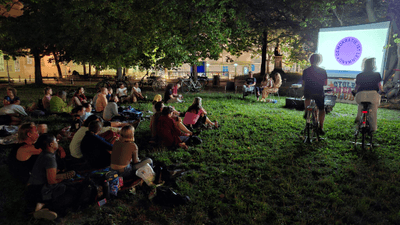
One belt-drive build logged 65–80 W average and 150–175 W peak over an 83-minute session 16. Zurich's VéloKino averages 50 W per bike, about 0.5 kWh an hour from ten pedallers 17. A schoolchildren's event in Ludwigsburg drew 400–500 W total from ten bikes 18. For scale, the BBC's Human Power Station reached 14 kW from eighty experienced club cyclists pedalling flat out — about 175 W each, a peak, not a sustained figure 19.
The planning figure and two worked examples
The planning figure is about 50 W of electrical output per casual adult rider, and riders needed ≈ load ÷ (chain efficiency × watts per rider). For a battery-buffered AC system, Low-tech Magazine's loss budget — generator 10–20%, regulator about 25%, battery 10–35%, inverter 5–15% — compounds to a worst-case chain efficiency of about 32.5% 19. Worked Example A: a 250 W AC load, the class Vienna's CycleCinemaClub runs, divided by 0.35 efficiency needs about 714 W at the pedals — roughly 14 riders at 50 W each, or about 10 at 75 W 19,21. KLAK's deployed design matches: a 340 W projector plus sound from ten riders at 50–60 W each against a 500 W inverter ceiling, with a LiFePO4 buffer absorbing the shortfall 3. Worked Example B is a single rider on direct DC. Removing the battery and inverter stages and keeping the generator in its efficient band — a measured 75–78% above 72 W, falling to 60% at 36 W and below 45% at 24 W — gives a derived pedals-to-DC net of roughly 60–65%, so at least 150 W of pedal input is needed for every 100 W that reaches the load 4. A rider sustaining 60 W mechanical therefore delivers about 40 W DC against an Optoma ML750e-class projector rated 45–65 W, which is why the Cinebike build buffers a single rider through two batteries rather than feeding the projector live 4,26,20. One lever is free: Low-tech Magazine's output doubled after cleaning and oiling the bicycle's drivetrain 4.
Promotional claims
Three promotional claims diverge from this range. A vendor cites "100 to 320 watts" per average adult rider 22; another cites "100 to 250 watts" per average person 23; and Brazilian operator BikeCine is reported in the press at about 200 W per cyclist 24. Each contradicts every operator and measured figure above, and two category errors explain them: quoting mechanical power at the pedals rather than electrical power after 30–60% of chain losses, and quoting a short maximal burst rather than a multi-hour event pace. A proposal whose arithmetic assumes 100 W sustained per casual rider is undersized by roughly a factor of two.

Systems that show this
-
Rock the Bike
Active last verified 2026-09United States · Equipment supplier
-
KLAK / Solare Zukunft e.V.
Active last verified 2026-09Germany · School programme
-
CycleCinemaClub
Active last verified 2026-09Austria · Nonprofit association
-
Electric Pedals
Active last verified 2026-09United Kingdom · Commercial hire
Read next
-
Explainer
Live-Wire, Battery-Buffered, Unbuffered: Three Topologies
How it works
-
Explainer
Roller, Hub, Belt, Rack: Four Coupling Families
How it works
-
Explainer
LED Projectors and Single-Rider Cinema
How it works
-
Explainer
Reading the Numbers: Confidence Labels, Statuses and Red Flags
Numbers
Sources
- [1]Rock The Bike — What are the elements of a Pedal Powered Stage?rockthebike.com
- [2]road.cc — Cyclists power family home on BBC show (2009)road.cc
- [3]Solare Zukunft e.V., Technisches Manual Fahrradkino, 20.12.2018fahrradkino.org
- [4]Low-tech Magazine — How to Build a Practical Household Bike Generator (2022)solar.lowtechmagazine.com
- [5]Powerful Thinking — The Power Behind Festivals, Edition 3www.powerful-thinking.org.uk
- [6]Morgan State University UMEC report — 2D Bicycle Modeling (Coggan power profile)www.morgan.edu
- [7]Appropedia — Bike blender (ergometer study compilation)www.appropedia.org
- [8]RoadCyclingGearGuide — Power Meter FAQroadcyclinggearguide.com
- [9]afasteryou.com — FTP by Age Chartafasteryou.com
- [10]TrainingPeaks — Fueling Insights vs. Gross Efficiency (2025)www.trainingpeaks.com
- [11]Zoladz et al. — J. Physiol. Pharmacol. 2023www.jpp.krakow.pl
- [12]ScienceDirect Topics — Metabolic Heat Production (citing Whipp & Wasserman 1972)www.sciencedirect.com
- [13]HERITAGE Family Study — Variation in cycling exercise mechanical efficiencypmc.ncbi.nlm.nih.gov
- [14]PedalPC — How Much Electricity Can a Human Generate?www.pedalpc.com
- [15]Helmholtz-Gymnasium Karlsruhe — Fahrradkino school report (event 12.01.2026)www.helmholtz-karlsruhe.de
- [16]PedalPowerGenerator.com FAQ — WattsVIEW sessionwww.pedalpowergenerator.com
- [17]Vélorution (Zürich) — VéloKinovelorution.ch
- [18]Landkreis Ludwigsburg — Fahrradkino press release (2024-11-29)www.landkreis-ludwigsburg.de
- [19]Low-tech Magazine — Bike-powered electricity generators are not sustainable (2011)solar.lowtechmagazine.com
- [20]Optoma ML750e set-up sheet (Farnell hosting)www.farnell.com
- [21]BIORAMA, 'Fahrradkino: Radeln für den Filmgenuss', 12 Jul 2018www.biorama.eu
- [22]New Atlas — Pedal-A-Watt stationary bike power generator (2015)newatlas.com
- [23]Chris Joseph — NRG people-powered installationchrisjose.ph
- [24]TMC — Bike Cine: telespectador gera energia limpa (BR press)tmc.com.br
- [25]Journal of Wuhan University (Engineering Science), '自行车动力发电系统分析', 2016www.xml-data.cn
- [26]Hackaday.io, Cinebike Human Powered Cinema — Instructionshackaday.io
Comments
Comments are reviewed before they appear. How comments and contributions are reviewed