
In-depth feature · How it works
An ultracapacitor box and a battery box: Rock the Bike
The Berkeley and Oakland manufacturer sells a Pedal Power Utility Box bridged by ultracapacitors for a few minutes and a battery-buffered Event Power Box that runs for hours, both fed by its 24 V hub-generator bikes.
Rock the Bike's Pedal Power Utility Box holds power for two to five minutes on an ultracapacitor; its Event Power Box stores kilowatt-hours in a battery. Both run from the Generator Pro's brushless rear-hub generator at a nominal 24 V — a hub, not the bottom-bracket flywheel some accounts describe.
“The Pedal Power Utility Box has an ultracapacitor that stabilizes the spiky DC power coming from bicycle generators… Continuous pedaling is needed to keep devices on. There is no battery, only an ultracapacitor lasting a few minutes.”
“What it does have is a large and effective brushless generator wheel. The size of it creates a flywheel effect that smooths out people's pedal strokes. The magnets and coils inside the hub never touch each other.”
“300W sustained output is very challenging for most pedalers to sustain!”
“the pedaling effort per person is approx. 50–75 Watts … the amount that an average audience member can continuously provide”
The Utility Box: minutes
The Pedal Power Utility Box accepts up to five bikes — ten pedaler inputs are described in the company's blog documentation — and states its design without hedging: "The Pedal Power Utility Box has an ultracapacitor that stabilizes the spiky DC power coming from bicycle generators… Continuous pedaling is needed to keep devices on. There is no battery, only an ultracapacitor lasting a few minutes." 1 The specified bridge is "a 2–5 minute buffer of power (depending on consumption levels)" ahead of a pure-sine inverter — rated 1,000 W on the original 2011 box, and 1,500 W (US) or 1,200 W (EU) on the current model 1. For years, secondary write-ups quoted a bridge time of 60 to 120 seconds; no current Rock the Bike documentation supports that figure.
Specifications
| Field | Value | Confidence | Sources |
|---|---|---|---|
| Utility Box pedalling inputs | Up to 5 bikes (10 pedaler inputs described in blog documentation) | 1 | |
| Utility Box ultracapacitor bridge time | 2–5 minutes, depending on consumptionCorrects a widely circulated 60–120 second figure that appears in no current Rock the Bike documentation. | 1 | |
| Utility Box inverter | 1,000 (2011 box); 1,500 US / 1,200 EU (current) W pure-sineThe 1,000 W figure belongs to the original 2011 product; the company's current model is rated higher, and both ratings are the vendor's own. | 1 | |
| Event Power Box inverter limit | 1,500 W | 2 | |
| Event Power Box battery, standard version | approximately 2.5 kWhImplied by the product page's own worked example — a 300 W PA running about eight hours — rather than printed as a capacity figure. | Estimated | 2 |
| Event Power Box battery, large option | 5 kWh ("roughly doubles" the standard runtime) | 2 | |
| Event Power Box chemistry and bus voltage | not disclosedNeither is printed on the product page; the "48 V LiFePO4" combination sometimes attributed to this product appears only in the company's separate do-it-yourself outage guidance. The energy-flow diagram above reproduces the research report's own wording for this stage. | Not disclosed | 2 |
| Generator Pro output | Nominally 24 V, "pegged to the load you connect" | Documented | 3 |
| Generator Pro rectifier cable | 20 ft, converts the hub's 3-phase AC to DC | Documented | 3 |
| Roll-Up roller | 6 in (152 mm) composite roller, doubles as a flywheel | Documented | 4 |
| Roll-Up generator rated output | 300 W continuousThe product page itself immediately qualifies this: "300W sustained output is very challenging for most pedalers to sustain!" | 4 | |
| Expected output, public-event rider | 50–75 WRock the Bike's own planning figure for what an average audience member can continuously provide. | Operator-stated | 5 |
The Event Power Box: hours
The Event Power Box "stores energy in a battery, accepts renewable inputs like solar and bicycle generators, and delivers standard AC power while showing the energy story on a daytime-visible display" 2. It sits behind a 1,500 W inverter limit, with a 5 kWh option that "roughly doubles" the standard version's runtime 2. The standard pack's capacity is not printed; the product page's own worked example, a 300 W PA running for about eight hours, works out to roughly 2.5 kWh, an inference labelled as an estimate rather than a specification. The pack's chemistry, its bus voltage and the inverter's waveform are not published on the product page either; the 48 V LiFePO4 combination sometimes attributed to this product appears only in the company's separate do-it-yourself outage guidance 2.

Energy flow, stage by stage1,2,3,4
- A: Pedaling
- A: Generator wheels (24 V nominal, rectified 3-phase)
- A: Ultracapacitor stabilization (2–5 min buffer)
- A: 1,000 W pure-sine inverter
- A: AC loads
- B: Pedaling
- B: Generator wheels (24 V)
- B: LiFePO4 battery (≈2.5 / 5 kWh)
- B: 1,500 W inverter
- B: AC loads (projector/PA)
The Generator Pro
The generation hardware behind both boxes is the Generator Pro, a purpose-built fixed-gear bicycle whose dedicated rear wheel contains a large brushless hub generator — not, as some accounts have it, a bottom-bracket flywheel drive. Rock the Bike explains why the size matters mechanically: "What it does have is a large and effective brushless generator wheel. The size of it creates a flywheel effect that smooths out people's pedal strokes. The magnets and coils inside the hub never touch each other." 3 Output is nominally 24 volts, "pegged to the load you connect," delivered through a 20-foot rectifier cable that converts the hub's three-phase alternating current to direct current; every Rock the Bike system runs on the same 24 V bus whichever buffer sits downstream 3. The hub generator is also sold as a retrofit rear wheel — the sLEDge and Svelte variants — for anyone who wants the coupling without a dedicated frame 6.

The Roll-Up stand and the 50–75 W planning figure
For customers bringing their own bicycles, the Roll-Up generator stand offers an external 6-inch composite roller that doubles as a flywheel, rated by the manufacturer at 300 W continuous; the same product page adds: "300W sustained output is very challenging for most pedalers to sustain!" 4 That matches Rock the Bike's separately published expectation for an event: "the pedaling effort per person is approx. 50–75 Watts … the amount that an average audience member can continuously provide" 5. It is sustained rider output, not a generator's nameplate rating, that sets the ceiling on a pedal-cinema system.

Which box
The Utility Box's few minutes of ultracapacitor bridge barely tolerate a slow rider swap; the Event Power Box's kilowatt-hours of battery tolerate almost any swap cadence, at the cost of carrying a large undisclosed battery into an occupied public space. The choice is between a visible link between effort and image and a screening that happens regardless of who is on the bikes.
Systems that show this
-
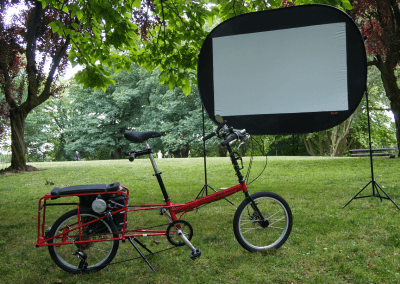
Open Air Cinema ("Cinebike")
Historical last verified 2026-09United States · Research or reference build
-
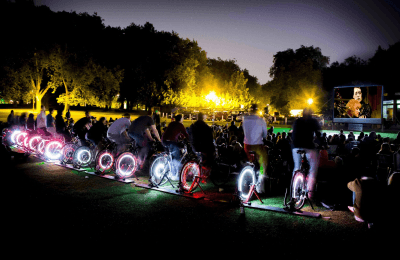
Electric Pedals
Active last verified 2026-09United Kingdom · Commercial hire
Read next
-
Explainer
Live-Wire, Battery-Buffered, Unbuffered: Three Topologies
How it works
-

Explainer
Buffers: Seconds or Hours
How it works
-
Explainer
Roller, Hub, Belt, Rack: Four Coupling Families
How it works
-
Explainer
Reading the Numbers: Confidence Labels, Statuses and Red Flags
Numbers
Sources
- [1]Rock the Bike — Pedal Power Utility Box (blog, 2011, current)rockthebike.com
- [2]Rock the Bike — Event Power Box product pagerockthebike.com
- [3]Rock the Bike blog — Generator Pro (2016)rockthebike.com
- [4]Rock the Bike, 'Roll Up Generator Stand' product pagerockthebike.com
- [5]Rock The Bike — What are the elements of a Pedal Powered Stage?rockthebike.com
- [6]Rock the Bike blog, 'Generators available from Rock The Bike'rockthebike.com
Comments
Comments are reviewed before they appear. How comments and contributions are reviewed