
In-depth feature · People
"The people are the batteries": Electric Pedals
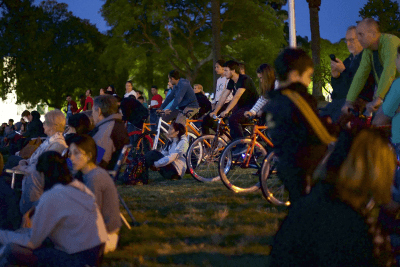
A South East London company builds its pedal cinemas in-house and generates all of their electricity live from the riders — no mains power, no stored battery energy — for hire fleets of two to twenty bikes.
Electric Pedals hires out live-wire pedal cinemas from a two-to-six-bike Small cinema to a twenty-bike Large cinema for audiences of 500 or more, and builds an 18 kg ultracapacitor backpack kit for conservation screenings. Its founder's planning figure for an average adult is 40 to 50 watts sustained for an hour.
“All electricity is generated live by the riders. No mains power. No stored battery energy.”
“The system uses no batteries. Rather the people are the batteries.”
“It uses ultra capacitor technology rather than batteries, making the system 100% pedal-powered, rather than relying on lithium batteries which would deteriorate over time.”
“an average human can maintain 40 to 50 watts for an hour”
The stated architecture
Electric Pedals, founded and run by Colin Tonks in South East London, builds its equipment in-house and states its architecture in one line: "All electricity is generated live by the riders. No mains power. No stored battery energy." 1 Where a battery-buffered system such as KLAK trades directness for continuity, Electric Pedals sells the visible dependency: if the riders slow down, the audience feels it within seconds.
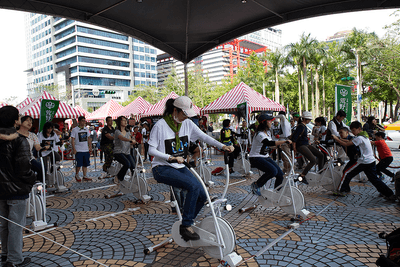
The hire range has two tiers, in the company's advertised figures. The Large cinema seats up to 20 riders, projects onto a 6.2-metre screen through an advertised 6,000-ANSI-lumen projector with two speakers rated 3,500 W each, for audiences of 500 or more 1; the Small cinema runs 2–6 bikes, a 2.3-metre screen, an 800-lumen projector and two 2,000 W speakers for up to 50 viewers 3. The loudspeaker figures are amplifier ratings, not consumption, and no projector wattage or measured electrical load is published for either tier. The projects page describes the large cinema as "up to 18 stations" with a 6-metre screen, while the hire page says 20 bikes and 6.2 metres; nothing public explains the gap, a fleet change between page updates is the likeliest account, and the figure stands as 18–20 2,1.
Specifications
| Field | Value | Confidence | Sources |
|---|---|---|---|
| Large cinema pedalling stations | 18–20 bikesThe hire page states 20 bikes and a 6.2 m screen; the projects page states 18 stations and a 6 m screen. This report treats the variance as a likely fleet change between page revisions, not a single fixed number. | 1,2 | |
| Large cinema screen | 6–6.2 m | 1,2 | |
| Large cinema projector | 6,000 ANSI lumens (advertised)Research correction:Advertised brightness on the operator's own hire page, labelled MFR by the research. Electric Pedals publishes no projector wattage at all, so this lumen figure says nothing about the electrical load the riders carry.The company's own hire-page advertising figure; no independent measurement exists. | Promotional / press-reported — not verified | 1 |
| Large cinema PA | 2 × 3,500 W speakers (advertised)Research correction:An amplifier rating, not consumption. The research labels this MFR and warns it must not be read as a 7 kW electrical load; actual PA draw for this rig is not disclosed.The hire page gives the figure without qualification. | Promotional / press-reported — not verified | 1 |
| Large cinema audience | 500+ people | 1 | |
| Small cinema — bikes, screen and audience | 2–6 bikes; 2.3 m screen; up to 50 viewers (advertised)Advertised on the Small cinema hire page. | 3 | |
| Small cinema — projector and PA | 800-lumen projector; 2 × 2,000 W speakers (advertised)Research correction:As on the Large tier, the speaker figure is an amplifier rating rather than consumption, and no projector wattage is published.Advertised on the Small cinema hire page. | Promotional / press-reported — not verified | 3 |
| OWL backpack kit weight | 18 kg, including projector | Documented | 4 |
| OWL backpack kit projector rating | 45 minimum / 65 maximum WOptoma's official ML750e datasheet figure; the Malawi case study itself does not print the projector's electrical draw, so lower figures circulating for this kit are estimates. | 5 | |
| Backpack cinemas deployed worldwide | 14 kits (Tanzania, Senegal, Uganda, Malawi, Congo, Madagascar) | Documented | 4 |
| Malawi roadshow reach | over 14,000 people in six weeksYear of deployment is not printed in the case study; context is consistent with, but does not prove, 2015. | Documented | 4 |
| DJ Derby 2012 fleet | 25 adult + 9 child bicycles + 2 hand-cycles | Documented | 6 |
| DJ Derby 2012 power budget | 1,520 W continuousThe source's own worked calculation runs on 20 adult, 10 child and 2 hand-cycle bikes, not the 25+9+2 fleet count above; both figures are reproduced as published. Planning averages: 60 W per adult bike, 30 W per child bike, 10 W per hand-cycle — not logged telemetry. | Operator-stated | 6 |
| DJ Derby 2012 total energy | 9,120 Wh across 6 hours | Operator-stated | 6 |
| Sustained output, average adult rider | 40–50 W for an hourFounder Colin Tonks's own figure; close to the value independently cited by KLAK and CycleCinemaClub. | Operator-stated | 7 |
No battery
Tonks has said it directly: "The system uses no batteries. Rather the people are the batteries." 8 In the same interview he described five years of powering "cinemas, music venues, radio stations, theatre productions, art installations and educational workshops—all of this without using a single battery" 8. What smooths stop-start pedalling into something a projector can use on the large rig is not published; ultracapacitor-class buffering there is implied by the no-battery claim but documented only for a smaller product.

Energy flow, stage by stage4,1,7,8,6
- Up to 20 riders (40–50 W/h per average adult, operator-stated)
- Custom in-house pedal generators (LED wheel lights as rider feedback)
- Power-management system with live energy feedback
- [No battery; ultracapacitor-class smoothing, implied not stated for the large rig]
- 6,000-lumen projector + 2 × 3,500 W PA (advertised ratings)
The OWL backpack kit
That product is the 18-kilogram "OWL" backpack cinema, built around an Optoma ML750e projector and described in Optoma's case study: "It uses ultra capacitor technology rather than batteries, making the system 100% pedal-powered, rather than relying on lithium batteries which would deteriorate over time." 4 The case study states that "the entire kit, including projector, fits into a rucksack," and that 14 kits were deployed across Tanzania, Senegal, Uganda, Malawi, Congo and Madagascar 4. The flagship deployment was a January roadshow with the Lilongwe Wildlife Trust in Malawi, screening conservation films about the illegal ivory trade, which "in six weeks, reached over 14,000 people" 4. The case study prints neither the year of the trip — context is consistent with roughly 2015 — nor the projector's draw; Optoma rates the ML750e at 45 W minimum and 65 W maximum, so lower wattages quoted for the kit are estimates 5.
DJ Derby, 2012
The company's most detailed published numbers predate its current product line. The UK industry guide The Power Behind Festivals documents the 2012 "DJ Derby" charity event: a six-hour show, roughly 5,000 people through the gate, power for 205 performing artists, and a fleet of 25 adult bicycles, 9 child bicycles and 2 hand-cycles 6. The guide's worked arithmetic runs on 20 adult bikes, 10 child bikes and 2 hand-cycles — a mismatch against the fleet count, reproduced as published — at planning averages of 60 W per adult bike, 30 W per child bike and 10 W per hand-cycle, for 1,520 W continuous and 9,120 watt-hours across the six hours 6. These are planning estimates, not metered telemetry, and the largest quantified pedal-event energy budget located in this corpus. The 60 W adult figure sits beside Tonks's rule of thumb — "an average human can maintain 40 to 50 watts for an hour" 7 — and the figures KLAK's manual, Rock the Bike's planning guide and Vienna's CycleCinemaClub each arrived at independently.
The technology also travelled by licence: Tonks stated in 2017 that "we now have three of our big bicycle cinemas touring through South America with our partner Efecto Cine" 8, the start of the chain that put Electric Pedals' live-wire rig to work in Montevideo and Santiago under local names.

Systems that show this
-
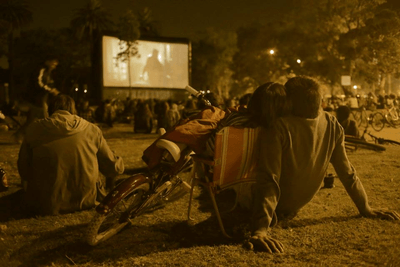
Efecto Cine / Efecto Pedal
Active last verified 2026-09Uruguay · Commercial hire
-

Market Chile — Efecto Pedal, Santiago
Historical last verified 2026-09Chile · Festival or event
-
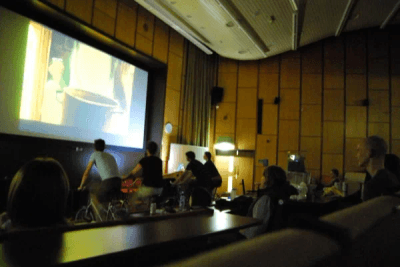
Reaction Bike Power
Active last verified 2026-09United Kingdom · Commercial hire
-
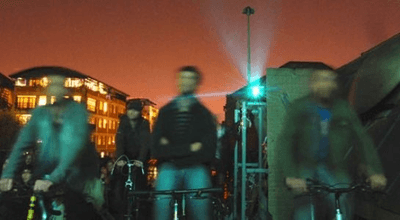
Magnificent Revolution
Defunct last verified 2026-09United Kingdom · Nonprofit association
Read next
-
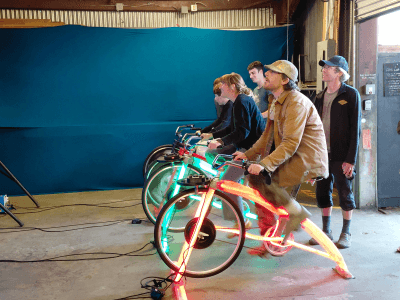
Explainer
Live-Wire, Battery-Buffered, Unbuffered: Three Topologies
How it works
-
Explainer
About Fifty Watts: What a Person Can Pedal
Numbers
-
Explainer
Manuals, Licences, Donations: How Pedal Cinema Spreads
People
-
Explainer
Reading the Numbers: Confidence Labels, Statuses and Red Flags
Numbers
Sources
- [1]Electric Pedals — Large/Small Bicycle Powered Cinema hire pageswww.electricpedals.com
- [2]Electric Pedals — projects: cinemawww.electricpedals.com
- [3]Electric Pedals — Large/Small Bicycle Powered Cinemawww.electricpedals.com
- [4]Optoma Europe case study #310 — Pedal powered cinema bringing films to remote areaswww.optomaeurope.com
- [5]Optoma ML750e datasheet and owner's manualdoc.av-connection.com
- [6]Powerful Thinking — The Power Behind Festivals, Edition 3www.powerful-thinking.org.uk
- [7]road.cc — Cyclists power family home on BBC show (2009)road.cc
- [8]adaptnetwork.com — Cinema goers can now power their own screening (interview with Colin Tonks, 2017)www.adaptnetwork.com
Comments
Comments are reviewed before they appear. How comments and contributions are reviewed