
In-depth feature · People
One bike, one rider, 196 watt-hours: the Cinebike
Open Air Cinema published its single-rider, battery-buffered Cinebike as a Hackaday build log; donated Cinebike-derived cargo bikes later powered Cine Bajo El Cielo screenings in Oaxaca.
A skateboard wheel machined into a friction spindle, a 24 V scooter motor, and two Goal Zero packs chained into a 196 Wh buffer. Open Air Cinema published the whole build — bill of materials, wiring, four stand redesigns — as Hackaday.io project 5665, the only complete build record located in this corpus.
“an outdoor theater entirely powered by the pedal strokes [of] the audience… A battery pack is included to act as a buffer so constant pedaling is not needed. A crowd of 30 people can enjoy a film and volunteer to pedal for 5 or 10 minutes each.”
“The Sherpa 100 batteries will take an input charge of 45 watts each, while our projector pulls over 60 watts… we use two batteries chained together in order to input 90 watts total into the system… At good events with adult riders, we have arrived with the batteries at 50% and left with them fully charged!”
“the entire film premiere is powered by a Haul-a-Day that generates electricity… The Cine Bajo El Cielo team has traveled 7000 miles to bring pedal-powered movies to over 50 communities in Mexico”
A build published in full
Open Air Cinema (OAC), an outdoor-cinema equipment company based in Utah, published the Cinebike as Hackaday.io project 5665, "Cinebike Human Powered Cinema", with its bill of materials, wiring diagram and design history 6,1. The company traces the idea to a specific screening: in January 2014 its inflatable-screen equipment showed the documentary The Square at the Maidan barricades in Kiev, and the Cinebike followed as "an outdoor theater entirely powered by the pedal strokes [of] the audience… A battery pack is included to act as a buffer so constant pedaling is not needed. A crowd of 30 people can enjoy a film and volunteer to pedal for 5 or 10 minutes each" 4. The prototype was tested at the Bicycle Collective in Portland, Oregon, with local e-bike and framebuilding partners 6.
Specifications
| Field | Value | Confidence | Sources |
|---|---|---|---|
| Generator | 24 V / 200 W electric-scooter motor (no make or model recorded) | Documented | 1 |
| Generator open-circuit voltage | 60 or more V from a strong riderNecessitates the voltage regulator; the motor spins in reverse because it is mounted on the wheel's left side, hence the deliberately cross-wired polarity. | Documented | 1 |
| Regulator output | 14.1 VJust above the Sherpa packs' 14 V minimum charge voltage. | Documented | 1 |
| Buffer | 2 × Goal Zero Sherpa 100 98 Wh each, ≈196 Wh combinedThe original 2014–2015 Sherpa 100 model, not the later Sherpa 100AC's 94.7 Wh. | 2 | |
| Charge input ceiling | 2 × 45 = 90 W total (45 W maximum per pack) | Documented | 1 |
| Projector draw | over 60 WBuilder-reported, not lab-measured; consistent with Optoma's official rating for the ML750-class light engine. | Operator-stated | 1 |
| Projector native input | 19 V DC, direct from the Sherpa packs' laptop port; no inverter | Documented | 1 |
| ML750e-class official rating | 45 minimum / 65 maximum W | 3 | |
| Rider rotation | 5–10 minute stints, audience rotation | Documented | 4 |
| Crowd referenced in Open Air Cinema's own account | 30 people, pedalling in shifts | Documented | 4 |
| Oaxaca lineage: communities reached | over 50 communities across Oaxaca, Chiapas and Veracruz | Documented | 5 |
| Oaxaca lineage: distance travelled | 7,000 miles (as of January 2017) | Documented | 5 |
The electrical chain
The generator is a generic 24 V / 200 W electric-scooter motor — no make or model survives in the build log — driven by a friction spindle machined from a skateboard wheel and pressed against the rear tyre. A strong rider "can put out 60v or more from the motor," so a custom voltage regulator between motor and battery steps the output down to 14.1 V, just above the buffer packs' minimum charge voltage 1. Because the motor is mounted on the left side of the wheel and spins in reverse, the wiring is deliberately cross-connected — black to red and red to black — at the regulator.
The buffer is two original Goal Zero Sherpa 100 lithium packs, each rated 98 Wh in the manufacturer's user guide — about 196 Wh combined, not the 94.7 Wh of the later Sherpa 100AC that some secondary descriptions substitute 2. The projector is an Optoma ML750, powered at 19 V DC straight from the packs' laptop port, with no inverter stage 7,8; a widely reprinted Hackaday news write-up's "Optomo 750" is a typographical error, not a different model. The builder states the power budget: "The Sherpa 100 batteries will take an input charge of 45 watts each, while our projector pulls over 60 watts… we use two batteries chained together in order to input 90 watts total into the system… At good events with adult riders, we have arrived with the batteries at 50% and left with them fully charged!" 1
No single casual rider sustains the projector's draw indefinitely; the 196 Wh buffer absorbs the shortfall between strong pedalling and steady playback, and the packs are chained because one alone would cap the charge rate below the projector's draw. The figures are builder-reported rather than laboratory-measured, but they hold together internally and match Optoma's official rating for the ML750e-class light engine, 45 W minimum and 65 W maximum 3. With no inverter, there is no stage between battery and lamp to lose efficiency to.

Energy flow, stage by stage6,7,1,4,2,8
- 1 rider at a time (audience rotation, 5–10 min stints)
- 24 V / 200 W scooter motor as generator (skateboard-wheel friction spindle on tire)
- Custom voltage regulator, 14.1 V output (reversed-polarity wiring)
- 2 × Goal Zero Sherpa 100, chained (2 × 98 Wh ≈ 196 Wh; 45 W max charge input each)
- Optoma ML750 at 19 V DC native (>60 W draw) + portable speakers
Four stands
The stand went through four documented redesigns before the production version, none of them the welded steel A-frame sometimes attributed to the project. A commercial trainer-stand concept was rejected as "not fun to pack while riding to a village at the top of a mountain"; an early stand "built from recycled bike parts" by a Portland bike artist was abandoned as "bulky, a bit dangerous"; an axle-mounted rear rack that rotates down to become the stand, co-designed with a local framebuilder and compatible with common trailer mounts, "worked great and was extremely stable"; and the production answer is a Bike Friday Haul-A-Day cargo bike with fold-down stand legs built into the frame 1.
Mexico
The OAC Foundation donated Cinebike-derived Haul-A-Day generator bikes to Cine Bajo El Cielo / "Ciclocinema" in Oaxaca, led by Claudia G. Covarrubias, which used them to power community premieres of locally produced children's stop-motion films. Bike Friday reported in January 2017 that "the entire film premiere is powered by a Haul-a-Day that generates electricity… The Cine Bajo El Cielo team has traveled 7000 miles to bring pedal-powered movies to over 50 communities in Mexico" 5. The programme continued across Oaxaca, Chiapas and Veracruz, and shorts from the project were broadcast on Canal 22.2 in December 2023 9. Open Air Cinema ran no events in Mexico itself; the build travelled as a published document and a donation.

Systems that show this
-
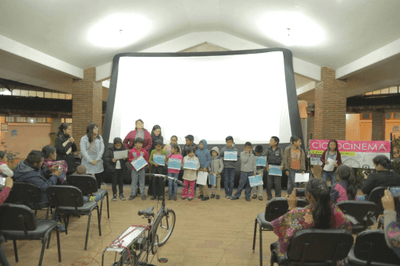
Cine Bajo el Cielo / Ciclocinema
Uncertain last verified 2026-09Mexico · Community project
-
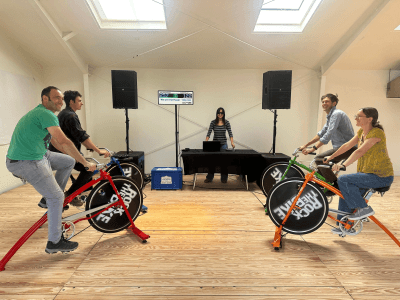
Rock the Bike
Active last verified 2026-09United States · Equipment supplier
-
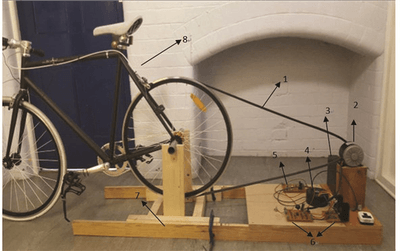
Wuhan University Bicycle-Generator Study
Historical last verified 2026-09China · Research or reference build
Read next
-
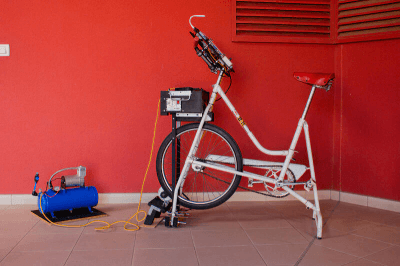
Explainer
LED Projectors and Single-Rider Cinema
How it works
-

Explainer
Manuals, Licences, Donations: How Pedal Cinema Spreads
People
-
In-depth feature
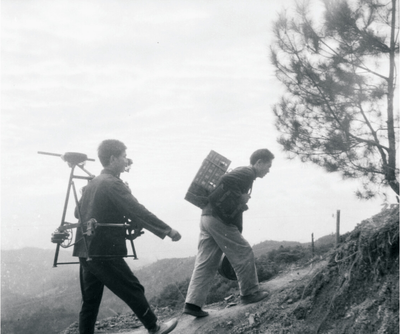
Pedal faster and the lamp gets brighter: China's rural pedal cinemas, 1960s–1980s
History
Sources
- [1]Hackaday.io, Cinebike Human Powered Cinema — Instructionshackaday.io
- [2]Goal Zero Sherpa 100 Power Pack User Guide (98 Wh)www.frankonia.at
- [3]Optoma ML750e datasheet and owner's manualdoc.av-connection.com
- [4]Open Air Cinema — Revolutionary Bicycle Cinema Systems (blog, 2019)www.openaircinema.us
- [5]Bike Friday — Pedal Powered Movie Magic in Mexico, 18/01/2017bikefriday.com
- [6]Hackaday.io — Cinebike Human Powered Cinema (project 5665)hackaday.io
- [7]Hackaday — A Pedal Powered Cinema (2015)hackaday.com
- [8]Hackaday.io project 5665 — Componentshackaday.io
- [9]Revista Bocetos — Ciclocinema: historias de mi comunidad (2023)revistabocetos.com
Comments
Comments are reviewed before they appear. How comments and contributions are reviewed