
In-depth feature · History
Pedal faster and the lamp gets brighter: China's rural pedal cinemas, 1960s–1980s
From about 1970, China's 8.75 mm mobile projection format ran on chain-driven pedal generators wired straight to the lamp in villages that had no electricity; rural electrification ended the practice from the mid-1970s.
Two projectionists facing each other pedalled a chain-driven generator wired straight to the lamp, with no battery between them. County gazetteers in Anhui and Shaanxi record commune film teams built around such generators from 1970 — the largest pedal-cinema deployment documented in this corpus, and one that rural electrification ended.
“配有脚踏式发电机”
Translation: equipped with a pedal generator
“一个比较完整的电影放映网初步形成”
Translation: a relatively complete film-projection network initially took shape
“那时村里没通电,放电影前要发电,只有脚踏发电机,放映中要不停地用脚踩踏才能持续供电。'我们经常是两三个人轮换着用脚踩,踏上半个小时大汗淋漓,一场电影放下来浑身都湿透了。'”
Translation: Back then the village had no electricity; before a screening you had to generate power — there were only pedal generators, and you had to tread continuously through the screening to keep the power on. 'We often had two or three people taking turns pedaling; after half an hour you'd be drenched in sweat, and by the end of a film you were soaked through.'
“踩快点灯泡就亮些,踩慢就暗些”
Translation: pedal faster and the lamp gets brighter, slower and it dims
A standardised format for villages without electricity
When China introduced the 8.75 mm film format for mobile rural projection around 1970–1971, villages that mountain electrification had not yet reached were served by purpose-built pedal generators adapted from bicycle frames and wired directly to the projector 1. County records describe the equipment in ordinary administrative language. Qimen County, Anhui, records that the commune film team it established in 1970 used an 8.75 mm projector "配有脚踏式发电机" — equipped with a pedal generator — because mountain electrification had lagged behind 1. Yichuan County, Shaanxi, records that from 1971 fourteen 8.75 mm projectors with pedal generators, donated in support of the Yan'an old revolutionary base area, formed fourteen commune film teams staffed by twenty-eight trained projectionists: "一个比较完整的电影放映网初步形成" — a relatively complete film-projection network initially took shape 2.
Specifications
| Field | Value | Confidence | Sources |
|---|---|---|---|
| Format introduced | c. 1970–1971 China's 8.75 mm mobile rural projection format | Documented | 1 |
| Qimen County, Anhui: first commune film team | 1970 established, 8.75 mm projector with a pedal generator | Documented | 1 |
| Yichuan County, Shaanxi: pedal-generator projectors | 14 units from 1971, forming fourteen commune film teams | Documented | 2 |
| Yichuan projectionists trained | 28 | Documented | 2 |
| Riders | 2 facing each other, tandem-style frameMemoir-sourced, like the generator rating below; the gazetteer record does not describe the frame. A contemporary interview separately recalls two or three people taking turns at the pedals. | Uncertain | 3 |
| Generator rating (memoir-sourced) | 12 V / 100 WSingle memoir source; recollection-based rather than measured or officially documented. Reported as uncorroborated, not as a specification. | Uncertain | 3 |
| Supporting-generator rating (industry history) | 300 W — differs from the memoir figure; reported as a conflictAn industry history of Chinese film machinery records 300 W supporting generators built alongside the 8.75 mm projectors; it does not reconcile with the memoir's 12 V / 100 W and may describe a different generator class. Reported as a conflict, not averaged. | Documented | 4 |
| Buffer | none direct drive, no regulation | Documented | 5,6 |
| Museum unit demonstration | December 2025 Sichuan University of Media and Communications museum | Documented | 7 |
| Wuhan University study | 2016 peer-reviewed, Journal of Wuhan University (Engineering Science) | Documented | 8 |
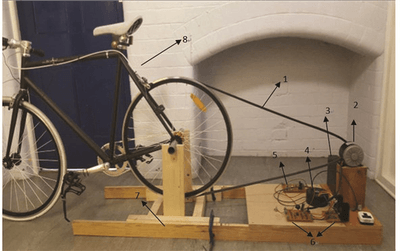
| Wuhan generator | 24 V / 250 W brushed DC motor at 2,750 r/min, belt-driven from a 660 mm rear wheel | Documented | 8 |
| Wuhan battery | 12 V / 22 Ah lead-acid, with overcharge and deep-discharge protection | Documented | 8 |
| Wuhan inverter stage | CD4047-based 50 Hz square-wave inverter, 12 V stepped up to 230 V | Documented | 8 |
| Wuhan generation efficiency | around 58 % at normal cadence (60–70 r/min) | Measured | 8 |
| Wuhan charge time to near-saturation | about 0.5 hours, to 95% of maximum voltage | Measured | 8 |
| Wuhan projector runtime per charge | 45 minutes | Measured | 8 |
| Wuhan average projector draw | around 58.2 W | Measured | 8 |
| Wuhan automatic cutoff | below 100 V | Documented | 8 |
Two riders, no buffer
The working experience survives in oral history rather than engineering documents. China News Service recorded Yunnan projectionist Li Shangting in 2018: "那时村里没通电,放电影前要发电,只有脚踏发电机,放映中要不停地用脚踩踏才能持续供电。'我们经常是两三个人轮换着用脚踩,踏上半个小时大汗淋漓,一场电影放下来浑身都湿透了。'" ("Back then the village had no electricity; before a screening you had to generate power — there were only pedal generators, and you had to tread continuously through the screening to keep the power on. 'We often had two or three people taking turns pedaling; after half an hour you'd be drenched in sweat, and by the end of a film you were soaked through.'") 9
Memoir sources describe the typical unit as a two-person, tandem-style frame with a 12 V / 100 W generator, a figure that rests on a single recollection rather than a measurement or an official specification 3. An industry history of Chinese film machinery records 300-watt supporting generators built alongside the 8.75 mm projectors; the two figures do not reconcile and may describe different generator classes 4. Every source, gazetteer and memoir alike, agrees on the architecture: direct drive, with no regulation and no buffer between the pedals and the lamp, so screen brightness tracked pedalling speed in front of the audience — "踩快点灯泡就亮些,踩慢就暗些", pedal faster and the lamp gets brighter, slower and it dims 5. A recollection from another province records the same effect on the screen: "有时候踩的慢了屏幕马上就暗了下来", sometimes when the pedalling slowed, the screen would immediately dim 6.

Energy flow, stage by stage1,2,3,9,5,6
- 2 riders facing each other on tandem-style frame (memoir: 12 V / 100 W generator)
- Chain drive from pedal sprockets
- DC generator
- [No regulation, no buffer — direct drive]
- 8.75 mm film projector lamp + mechanism (brightness tracks pedaling speed)
A 2016 laboratory measurement
The measured counterpart to that oral history is a 2016 peer-reviewed study in the Journal of Wuhan University (Engineering Science), motivated by pedal-powered open-air cinema 8. The Wuhan team instrumented a whole chain: a single-speed bicycle with a 660 mm rear wheel, belt-coupled to a 24 V brushed DC motor, charging a 12 V / 22 amp-hour lead-acid battery, feeding a CD4047-based inverter that stepped 12 V up to 230 V 8. They measured a generation efficiency of "around 58%" at a normal cadence of 60 to 70 revolutions per minute, charging to 95% of maximum voltage in about half an hour, and a full battery sustaining the projector for 45 minutes at an average draw of "around 58.2 watts" 8. It is the only peer-reviewed, fully measured pedal-cinema energy chain located in this corpus, and its per-rider figure lands within a few watts of the 50-to-60-watt constant that KLAK, Electric Pedals and CycleCinemaClub each arrived at independently.


What remains
A working unit from the original era survives at the Sichuan University of Media and Communications museum and was demonstrated in operation in December 2025, still driving an 8.75 mm projector more than fifty years after the format's introduction 7. Rural electrification erased the system class from the mid-1970s onward, and the surviving period photographs show the work around the light rather than the making of it: a film team carrying its equipment into the mountains, a lit screen at night, a projector on its case. The one period photograph of the apparatus itself located for this page — a county-archive image from Tongshan, Hubei, dated 1975 — catches it in transport: two projectionists climbing a path at dusk, the bicycle-frame generator on one man's back. The half-hour of mid-show pedalling, in the dark behind the audience, left no image.
The six-language search found no pedal-cinema provider, commercial or nonprofit, operating in Mainland China, Taiwan or Hong Kong; the modern Chinese 发电单车 (generating-bicycle) industry builds interactive lights, fountains and phone-charging carts, not cinema 10.


Systems that show this
-
Wuhan University Bicycle-Generator Study
Historical last verified 2026-09China · Research or reference build
-
Society of Wilderness — Starlight Cinema
Historical last verified 2026-09Taiwan · Festival or event
Read next
-
Explainer
LED Projectors and Single-Rider Cinema
How it works
-
In-depth feature
One bike, one rider, 196 watt-hours: the Cinebike
People
Sources
- [1]Qimen County government — local historywww.ahqimen.gov.cn
- [2]Shaanxi provincial gazetteer — Yichuan County annalsdfz.shaanxi.gov.cn
- [3]Douban memoir 《老康的五十年电影放映生涯》www.douban.com
- [4]中国文化办公设备制造行业协会《中国电影机械工业发展回眸》(曲金魁编, 2006)www.ccoea.org.cn
- [5]Yangjiang Daily — 脚踏发电放电影 (2024)m.yjrb.com.cn
- [6]Sohu — 90年代的乡村电影 (2020)www.sohu.com
- [7]川观新闻 — Sichuan museum report (2025)cbgc.scol.com.cn
- [8]Journal of Wuhan University (Engineering Science), '自行车动力发电系统分析', 2016www.xml-data.cn
- [9]China News Service — 一家三代的电影人生 (2018)www.chinanews.com.cn
- [10]悦派 Yeapar product page, 2020www.yeapar.com
- [11]People's Daily — 世界屋脊上的星空电影院 (2023)No direct link in the registry; the research cited this source through indexed excerpts.
Comments
Comments are reviewed before they appear. How comments and contributions are reviewed